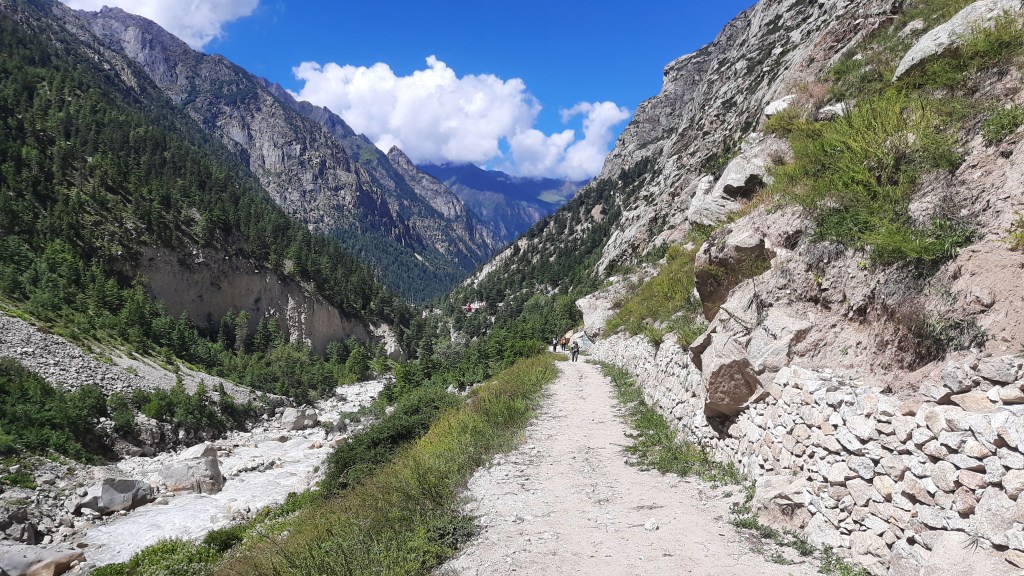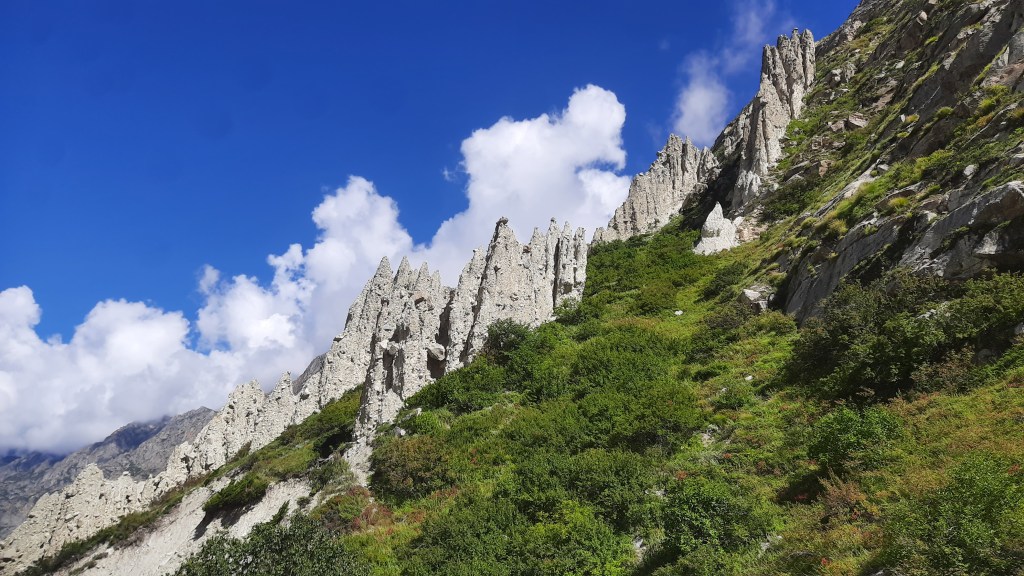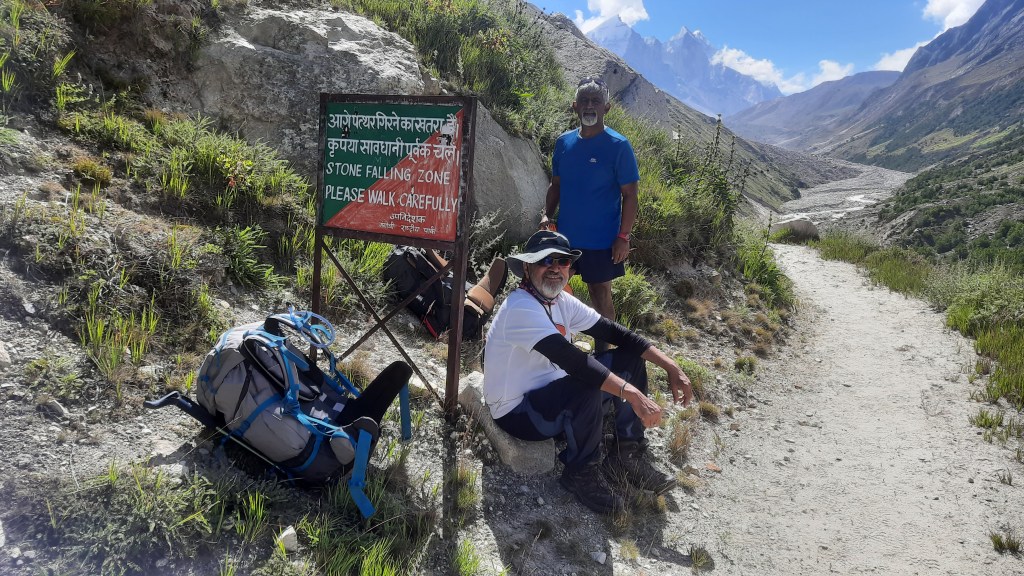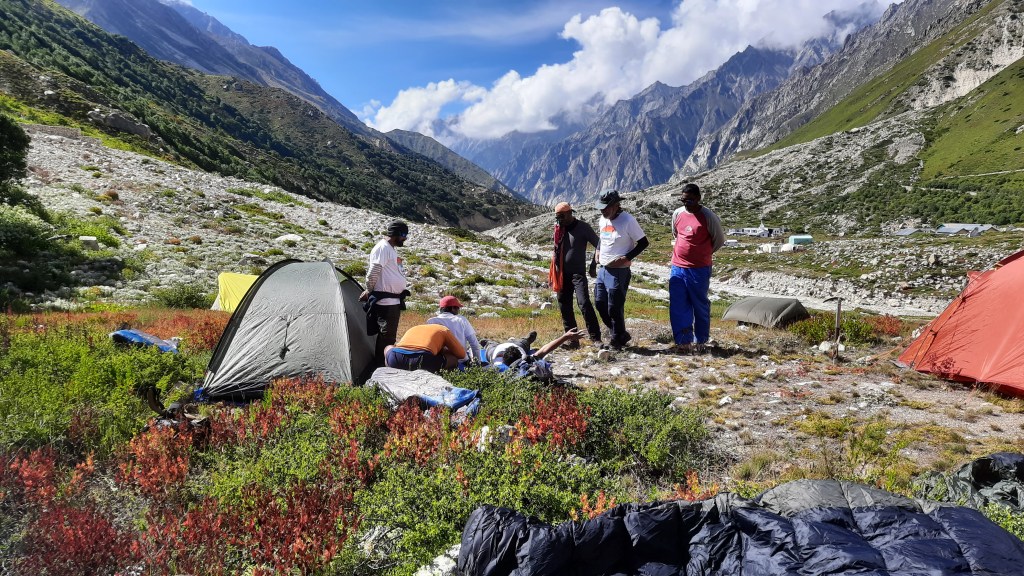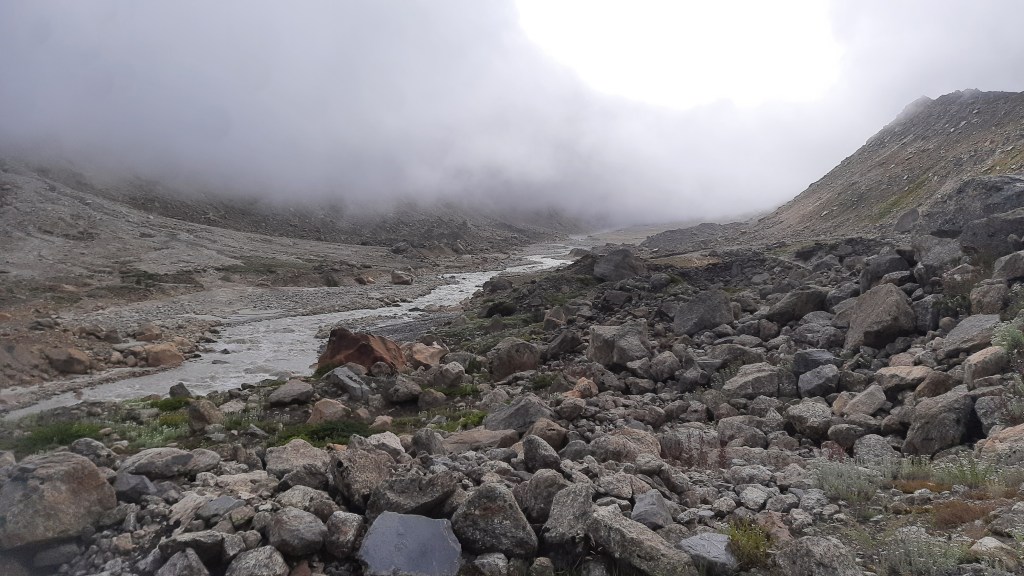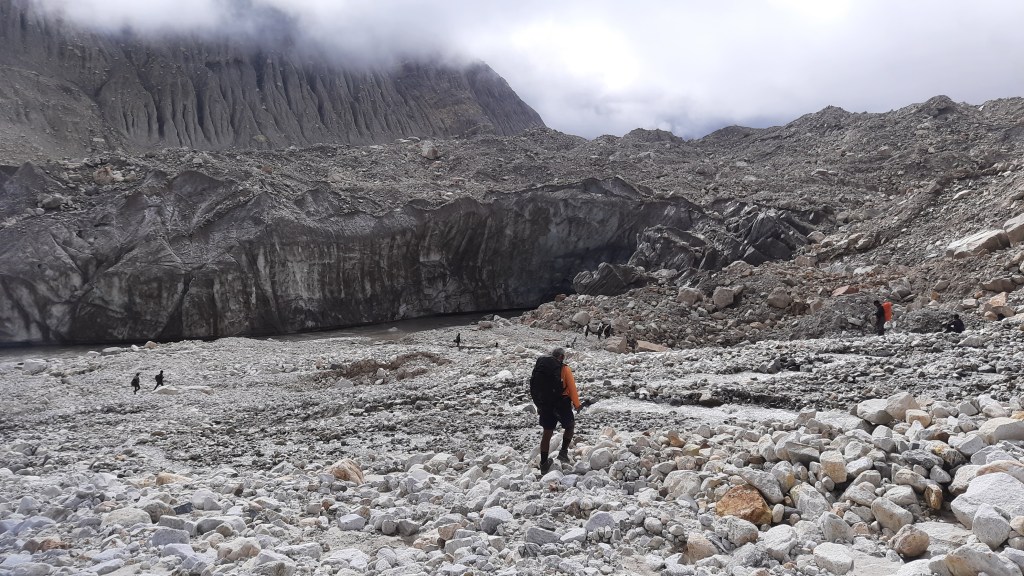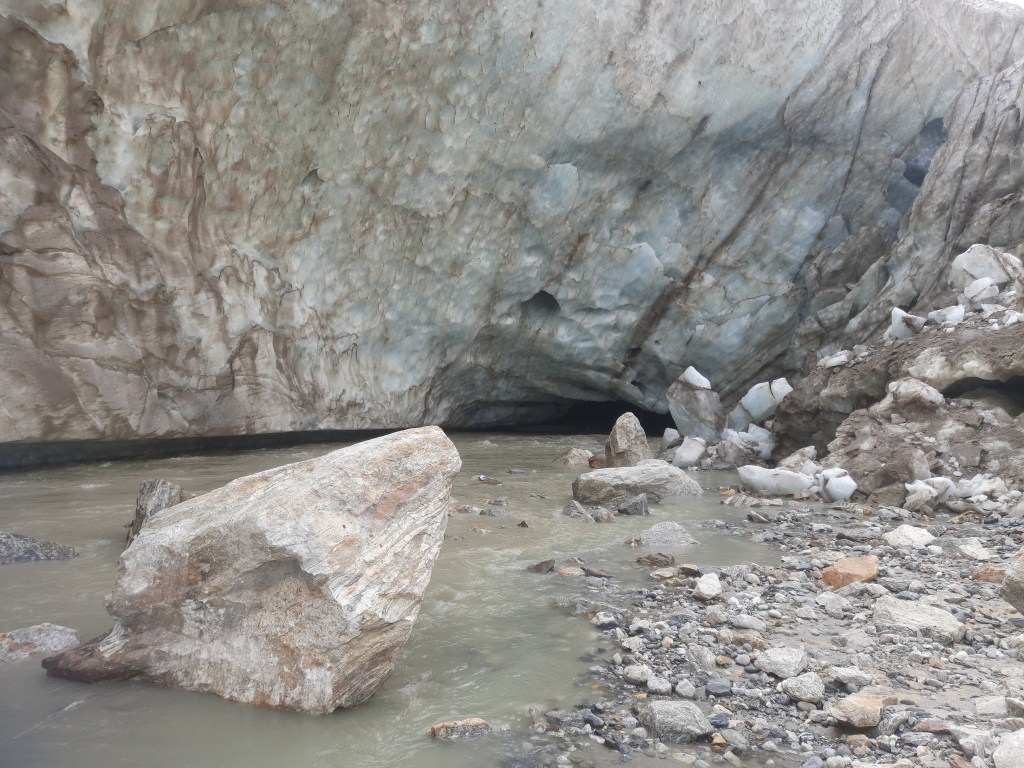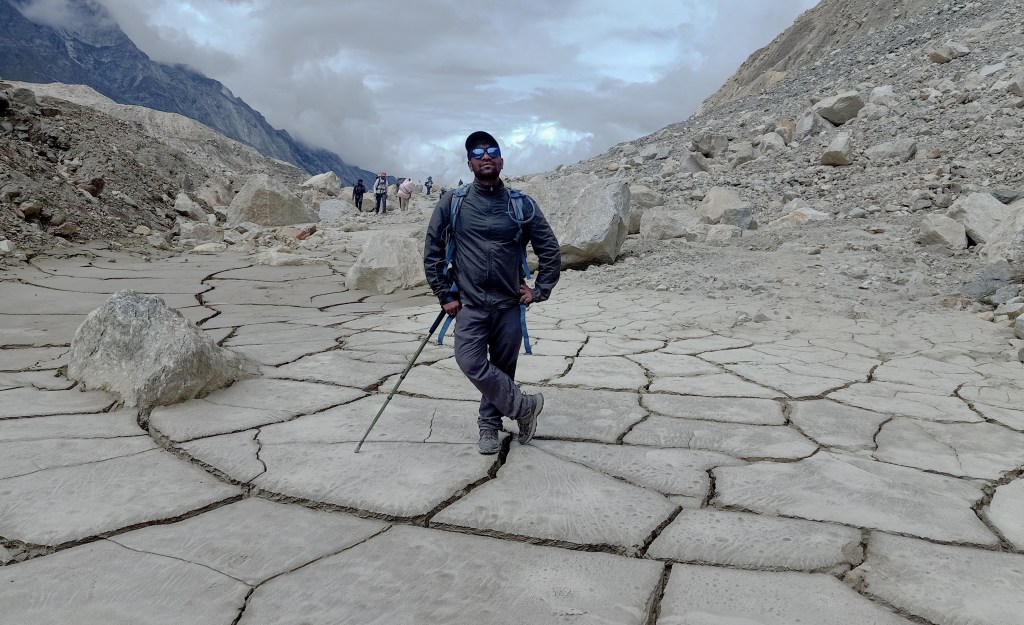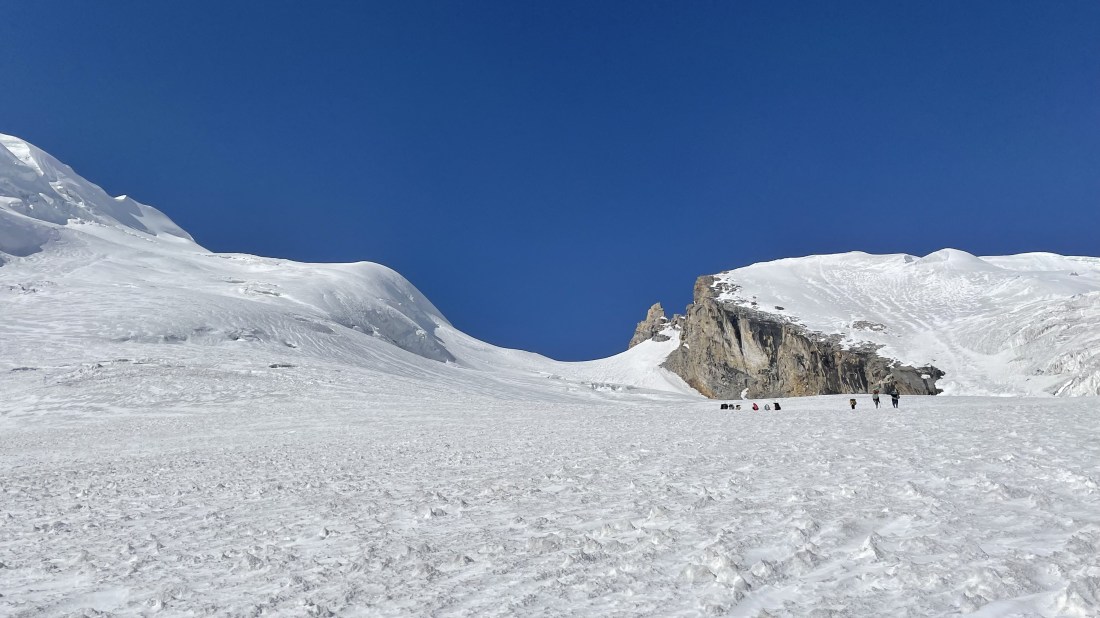
Precipitous Patangini | Astounding Auden’s | Mesmerizing Mayali

I was never interested in mathematics. Nevertheless, the numbers show that I have an opportunity for a couple of glamorous Himalayan treks. This would happen within a span of just 9 months. I eagerly did all the necessary mathematics. I got an opportunity to join the extraordinary trek from Gangotri Temple to Kedarnath Temple. The trek passed through Patangini Dhar, Auden’s Col, and Mayali Pass. This took place in June 2022. The Kalindi Khal trek was just finished 9 months before in September 2021.

Sonu Negi, the founder, and leader of Raacho trekkers, encounters this significant stretch every year. They come to Harshil from Chitkul, crossing the Lamkhaga pass with his group of support staff and clients. They are an amazing team in many ways.

Navtej Ji told me that this would be his last long trek and asked me to join. I was more than ready. The coronavirus scare was ending. Hence, there was some turmoil as I had to join an office in Bangalore. But never really had a break from my workout plan till I came back from Kalindi. Rahul Bhai, Devdutt Ji, Anjan Da, Dr. Sanjay, and Raktim were joining us from our old group. I Shifted to Bangalore a month before the trek. Raktim joined me often for morning workouts and we had some day hikes around Bangalore on the weekends.

Lijo joined me and Raktim in Bangalore airport on 3rd June for an evening flight to Delhi. Lijo is a super silent guy. So, Raktim and I kept blubbering while Lijo acted as a silent listener. Raktim was nervous as it was a trek after a long gap for him. We took a cab from Delhi Airport to Hazrat Nizamuddin, where Navtej Ji, Dr. Sanjay, and Rahul Bhai joined us for the Nanda Devi Express.

We all were carrying our vaccination certificates. Still, unlike the last time, there was no checking at Dehradun junction on the 4th morning. Anjan Da, who arrived last evening, joined us at the station. Our tempo traveler was waiting outside the station. We arrived at the President Hotel in Doon City, where Devdutt Ji had spent the last night, to freshen up. It was a sixteen-seater tempo, and we were only eight souls to travel. So, our backpacks fit inside easily. We had a couple of breaks for breakfast in Subhakholi and lunch at Bhatwari. The reunion of the old group was so exciting and joyous. We didn’t realize the journey of 250 kilometers on the mountain road. We reached Gangoti at 7pm. Dr. Amit and Jitender reached almost at the same time. They came to Dehradun airport that morning and took a cab to Gangotri directly.

Ever-young Bhagirathi flowing by the Gangotri. P.C. Arpan Sarkar

Sonu and his team were waiting for us at a riverside hotel. They welcomed us with coffee and pakoras. We kept our backpacks in one room and headed to the temple for the evening Aarti. The high mountains around the temple were still amusing me. Me, Raktim, and Lijo had a calming hour sitting in front of the temple. The crowd seemed too much as my last visit was in

Gangotri temple in evening glory. P.C. Arpan Sarkar

Corona restriction. Me, Raktim, Rahul Bhai, and Anjan Da settled in the GMVN guest house that night. It is located just in front of Surya Kund. Devdutt Ji distributed us the trek t-shirt that I designed for the team. It was a good night’s sleep with a blanket and at some distance from the ground, as the next 13-15 days would have to be rolled in sleeping bags on various kinds of territories.

Surya Kund. P.C. Arpan Sarkar

5th June 2022 (Gangotri-3023 mt to Bhuj Khadak-3770 mt; 5.5 km trek)

We woke up early. We packed last night’s items. Then, we met with the rest of the team. They were staying in a homestay just beside the Bhagirathi River. Warm coffee and breakfast were waiting for us. Me and Raktim took a stroll along the market alley for the last round of shopping before

Courtesy: Google Earth

we left civilization and ended up buying some chocolates and smokables. It was a pleasant surprise to find Devram Negi there. Devram was our guide for Kalindi and later on, developed a trekking business with Utkarsh. He was leaving for the Gomukh-Tapovan trek with his clients.

The trail along the Kedar Ganga gorge. P.C. Arpan Sarkar

At 8:30 we parted ways with Devram and approached along the left bank of Bhagirathi. Our plan was to reach Kedartal as an acclimatization walk and the real climb to start from there. We took the south route that goes up along the gorge of Kedar Ganga. It was a challenging gradient for the first day of a trek. The route was well-defined and mostly covered with birch trees. Surya Kund was about 20 feet deep from the settlement. Within 30 minutes of the trek, Kedar Ganga descended approximately 350 feet into the gorge. Spider Wall was one of the infamous sections in this route, but we found it manageable. It was a big monolith that used to be without any gripping hole. Trekkers struggled a lot with this section in the past. However, we found it cracked

The crack between Spider Wall. P.C. Arpan Sarkar

in the middle, which gave us a way to cross it easily. Mt. Thalaysagar started playing hide and seek. There was one loose rockfall section just before the campsite that needed some extra attention. We took intermediate halts with some chitchats and reached the campsite at 12:30. It was a small, plain ground just after the end of the treeline. It barely fit all of us. Big bushes of wild spinach surrounded it. Within a couple of hours, we lost the sunlight. A big sharp mountain wall on our west in the narrow gorge blocked it.

The loose section before the campsite. P.C. Arpan Sarkar

The evening was comparatively colder, accompanied by the nice snacks and soups coming out of the kitchen tent. Another team consisted of two members from Kolkata and one support staff. They camped on a nearby plain with the intention to trek Kedartal.

Mt. Talaysagar peeking from behind. P.C. Arpan Sarkar

We took an acclimatization walk just to support the theory “climb high, sleep low”. The star-gazing night was amazing to welcome us on the first day into the wild.

The Bhuj Khadak campsite. P.C. Arpan Sarkar

6th June 2022 (Bhuj Khadak to Kedar Khadak-4323 mt; 3.75 km trek)

Rays of hope. P.C. Arpan Sarkar

We started early at 8:20 just after breakfast. The light beams through the high mountains kept us motivated. The gradient was like the last day. Still, the loose earth patches in between kept us reminded that it was not the same day or altitude anymore. Some mountain goats were standing higher than us on a loose section. They kept kicking rocks down. This made it more challenging. The route continued along the gorge with the river lying deep down.

Leaving the tree line behind. P.C. Arpan Sarkar

Sunlight hit us quite late because of the narrow gorge with high walls. The gorge opened up in a while. Along with it, the snow-capped wonders started to show up one after another. After one and a half hours of walking, we reached the side of the river. We continued walking along with it. The ground was mostly loose and the Kedar Ganga was flowing in high volume.

Wide open valley and a prominent trail. P.C. Arpan Sarkar
We came down to the river bank. P.C. Arpan Sarkar

We reached the campsite at 12. It was one of the most spectacular campsites I have ever been to. Manda group, Brigupanth, Thalaysagar, Jogin group, and the wall of Patangini range were all around us. It felt like sitting in a huge amphitheater with the grandest view of tall white wonders. The incline of Patanging Dhar was lying on the west. It was a sunny day and there was no place

The magnificent Kedar Khadak campsite. P.C. Arpan Sarkar

to hide from it in that open ground. We kept roaming around and clicking pictures. There was a narrow and shallow stream flowing across the place. Some of our support staff pitched their tents on the other side of where we camped. The ground was so huge that it could fit a cricket stadium in it. After lunch, we started searching for mobile networks on a suggested spot but couldn’t find any.

The amphitheater. P.C. Arpan Sarkar

Once the sun went down party mood took over. A happy and healthy camp went to sleep late that night.

7th June 2022 (Kedar Khadak to Kedartal-4823 mt and back to Kedar Khadak; 6 km Trek)

The vibe in the morning was of a lazy Sunday. The only job was to stroll to Kedartal and come back before lunch. We had a heavy breakfast and started at 8 with only water bottles in hand. The direction was to follow Mt. Thalaysagar. Everyone was in a holiday mood, so the number of photographs captured was comparatively higher than the other days. Me, Rahul bhai, and Raktim were walking together. It was majorly a walk through a long dried glacier. Some of the glacial pools were still there, probably fed by fresh snowfall. As we approached the Kedartal, the

On the way to Kedar Tal. P.C. Arpan Sarkar
Part of the team. P.C. Raktim Duttagupta

grandeur of the place kept opening. Once reached the top of the last ridge, I was spellbound. Kedartal was probably the most serene place I have ever been to. The sparkling lake of turquoise blue color was surrounded by snow-bodied giants leaving me wondering for a long time. I slowly started descending to the lake. I sat on a big boulder by the side of the waterbed. I didn’t speak to anyone. I didn’t feel blubbering, just wanted to feel the tranquility.

Kedar Tal and surrounding. P.C. Arpan Sarkar

Kapil, one of our guides, went to Thalaysagar Base Camp. He went to meet his friends who were attempting the summit. It was about a kilometer away from us. We all felt that a camp on the bank of Kedartal would have been overwhelming. On a clear night, watching the astronomical activities would be an unearthly experience. Nonetheless, camping there is banned these days. I never felt like leaving that place. But with the team, I also started the returning stroll.

Historical! P.C. Arpan Sarkar
Kedar Tal. P.C. Arpan Sarkar

I was mentally overwhelmed but my belly was not synchronizing with it. So, had a decent lunch on our return to the campsite. Lijo was feeling down and wanted to return to Gangotri. Navtej Ji and Dr. Sanjay motivated him to continue. They promised him that if he felt the same after the next day, he could return through Rudragaira Valley. This arrangement would be made. We roamed around the place. We kept gazing toward the incline of Patangini Dhar. It looked like a super challenging morning was coming up next. There was no patch of snow visible on the gradient. However, later Sonu sent us photographs taken on the 2023 expedition. They showed that the incline and the summit were all covered with snow. Kapil returned a little late. He informed us that his friends were planning to wrap up the Thalaysagar summit attempt. The reason was a shortage of ropes, strange!

8th June 2022 (Bhuj Khadak to Dabba-4702 mt through Patangini Dhar-5190 mt; 7.1 km trek)

The super early climb started at 5:40. It was quite a foggy morning in the Kedar Ganga valley. After crossing a small stream, we started the incline. It was not a percent less than it looked from a distance. Initially, there was a hump that we crossed. Once after that, it was a continuous incline probably in 65 degree gradient. One can see the summit throughout but it

Foggy start of a long day. P.C. Arpan Sarkar

always felt far from reach. We had a plan of setting up a camp on Patanging base but only on paper. I don’t think that I have seen a place where a single tent can be accommodated. There was barely a rock to place your butt for a while. We struggled but kept climbing. Meanwhile, the weather was opening up and the views toward Kedartal were getting clearer. After a while the peaks behind Manda and the surroundings of Gangotri were in our viewing range. In climbs like this motivation is quite important as the act is monotonous. The emerging views and looking behind to see the climb I have completed, always fuel me. I did Stok Kangri in 2019 and I felt the climb of Patangini Dhar was tougher. Probably the show cover on Stok made the climb comparatively easier. Patangini was completely naked that year. After quite a struggle I reached the pass at 10.

It was a continuous incline. P.C. Arpan Sarkar
Quite a climb! P.C. Arpan Sarkar

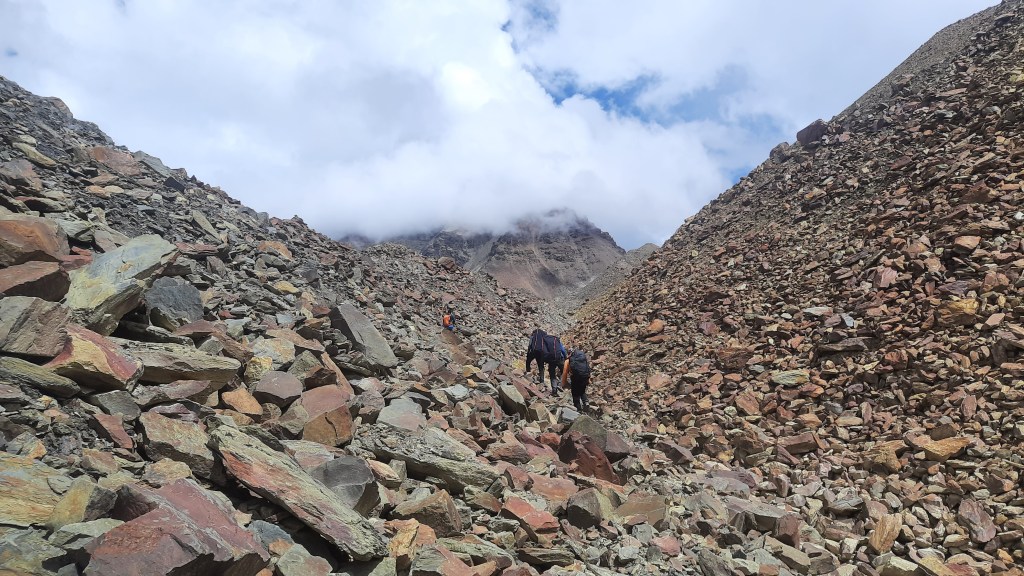
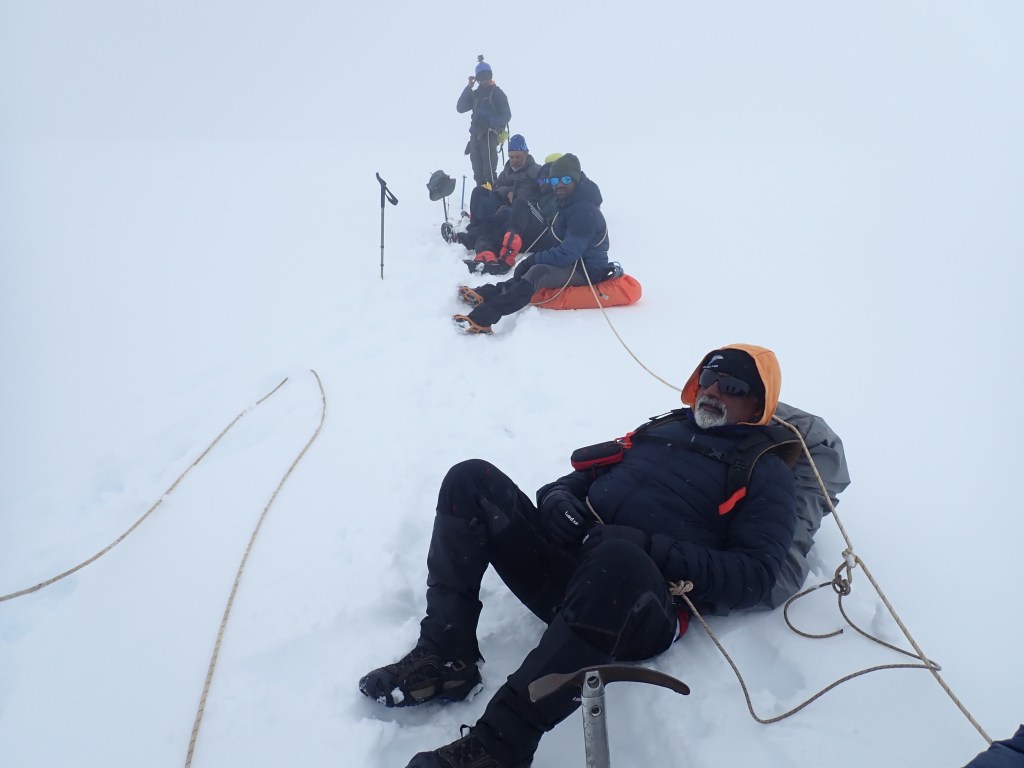
“Dhar” means sharp in Hindi. The one who named that place must have a great sense of humor and descriptive skill at the same time. By adding Dhar to Patangini, that person has described the place with great irony. It was literally a knife-sharp continuous ridge that can fit only one person on it. The only way all can fit is by standing in a queue. The Rudragaira Valley, the Gangotri group of Peaks, and the glacier were visible from there. I kept my backpack and soaked the beauty of both the valleys. It took around an hour to gather everyone on the sharp edge. Rajib, one of Sonu’s assistants had blood coming from his nose probably because of dry weather and sudden altitude gain. Dr. Sanjay treated him. We spent quite a long time on the pass.

Patangini Dhar-5190 mt. P.C. Arpan Sarkar

The support staff started the decline at 11:15 to the Rudragaira side, and we followed them. Straight from the summit, there was a 150 mt continuous drop in a significant gradient. It was a fitting downhill to the incline. Loose rocks didn’t allow us to speed up. We hit the first patch of snow after that. The knees were feeling relaxed walking on the snow after the tough toil. Once we reached a comparatively settled place after crossing a few snow patches, it was time for our

A fitting descent. Mt. Rudragaira is behind the cloud. P.C. Arpan Sarkar

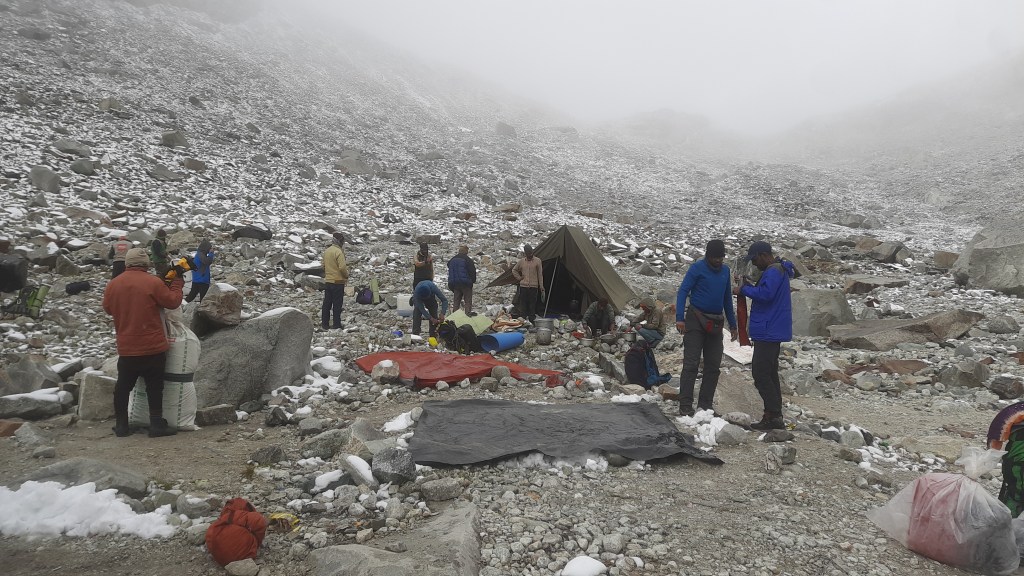
packed lunch. The first glimpse of Auden’s Col was visible from there. The Rudragaira Peak was standing straight ahead of us. The place was a moraine zone of the nearby glaciers. Hence, there was no clear visibility of the campsite. We kept tracking our support staff. At 3:30 we reached the campsite on the foothill of Jogin.

Happy camp-sight to us! P.C. Arpan Sarkar

Some freshly fried Pakoras and hot coffee saved the souls. Sonu told us that we should have been faster as the challenges ahead were not easy either. We went inside the tents and started lazy chitchats comparing the Patanging climb with our other experiences. I don’t think anyone was awake that night after 8. It was quite a long day!

Dabba camp. The peak visible is Jogin I. P.C. Arpan Sarkar

9th June 2022 (Dabba to Advance Auden’s Base Camp-4902 mt; 5.9km trek)

I went to brush my teeth by the side of a stream flowing near to our campsite. A big boulder looked quite satisfactory to settle on. I stepped on it, slipped, and fell bang on. A very thin layer of ice covered the rock. It reduced the grip of my shoe. The ice was not noticeable at all. Luckily there was no injury. In high mountains, this is a very common phenomenon in places surrounded by big elevations. The temperature drops significantly at night and creates thin layers of ice with the moisture available in the air.

The full group of members. Standing from left: Eshaan, Jitendra, Pranav, Parjanya, Raktim, Arpan, Lijo, Dr. Sanjay, Mohit, Anjan. Sittng from left: Shyam, Navtej, Rahul, Dr. Amit, Devdttt. P.C. Decdutt Lall

We started at 8 for Auden’s Advance Base Camp. The elevation gain was not much that day. It was mostly a walk along the glacier that is coming from Jogin I and Gangotri III. The magnificent view of the Auden’s Col was coming closer slowly toward us. The weather turned gloomy by the time we reached the crossing point of the glacier. This glacier comes in

Distant sight of Auden’s Col and Gangotri III. P.C. Arpan Sarkar

between the two routes coming to Auden’sCol from Gangotri. The other route comes along the left side of the Rudragaira River and later the glacier. The base camp and the advanced base

Down to the glacier. P.C. Arpan Sarkar

camp for Auden’s Col is set up on the west side of the glacier. So, we needed to cross the glacier to reach the campsite. It was a white icy highway. Once we stepped on it, the crunchy sound of hard ice breaking under our shoes started to come in. Toward the other side of the glacier, there was a glacial stream flowing along. A risky long jump took us to the other side. By the time we reached the campsite at 3, it was snowing heavily.

The ABC, Glacier, and Auden’s Col. About to reach the campsite. P.C. Arpan Sarkar

Our support staff was very generous. They transferred all the eatables from the kitchen tent to our tents that day. After a heavy snowfall, a starry night over the U-shaped Auden’s Col emerged before we got inside our sleeping bags. We slept early that night as the big day was waiting for us on the other side.

10th June 2022 (Auden’s Advance Base Camp to Khatling Glacier -4975 mt through Auden’s Col-5490 mt; 4.6 km trek)

The big day had a clear sky to offer. The time I woke up at 4:30, the sky was bluish but there was no sunlight on the peaks yet. The kitchen offered us boiled eggs, boiled potatoes, chocolates, and dry fruits as packed lunch. Sonu didn’t rope us up, as he thought that it was not important for Auden’s climb. We were wearing the crampons and the gaiters already as the snowfield started just after our campsite. It was a very brief breakfast that morning.

The picturesque Col. P.C. Arpan Sarkar

We started at 5:20. As we were camping at ABC, the incline started instantly. Sonu let us follow the middle route depending on his past experience. He often mentioned the glacier’s depreciation. Still, I personally felt that the snow was less that year. At 6:20, the sun touched the Gangotri III. We just crossed the first hump then and the support staff were still dismantling the camp far down. We touched the sunlight at 7:30 and it felt warm

Too far yet. P.C. Arpan Sarkar

straight away. The Col seemed far and we kept climbing slowly. About in the middle, there was a huge crevasse. To traverse it, we took a left turn toward Jogin. Once after that, we continued zigzagging. The number of crevasses also kept increasing once after halfway.

The huge crevasse. P.C. Arpan Sarkar
An intermediate break. P.C. Arpan Sarkar

Dr. Amit was the first one to reach the summit at 10:20. I followed him. It was cloudy toward Gangotri but the surroundings of the pass seemed clear. The t-shirt I designed had a catch line “The rabbit is calling”. This is because of the two rabbit ear-like rock structures on both sides of the Col. These rabbit ears are more visible from the Khatling side. We started celebrating with joy. Everyone joined us one after another. Auden’s Col is one of the most picturesque passes. It has vast views on both sides and adequate snow cover along with emerging rock structures. Adding to all features, the Col is between two famous high mountains Gangotri III (6,577mt) and Jogin I (6,465 mt).

Panorama with both the Rabbit ears. P.C. Arpan Sarkar

The other side of the pass looked scary. The infamous Khatling Glacier was waiting for us with a sinister cover of clouds. The scar-like crevasses all over it ran a chill through my spine. We had crossed a significant height of Patangini Dhar earlier. This acclimatization allowed us to spend almost a couple of hours on the pass. We had our packed lunch meanwhile. Once all of our support staff reached the Col, we started to descend.

Auden’s Col, 5490 mt. P.C. Raktim Duttagupta

Kapil fixed a rope for rappelling. Because of less snow that year, glissade was out of the question. It was quite a sharp downhill experience. There were 3 sections of it. In the first section, we rappelled down for 150 meters in a 75-degree gradient. Then a rocky section stands in between the decline. The key challenge was to manage the grip of our shoes attached to crampons on the

Sonu guiding through the rappelling section of descend. P.C. Amit Singh

naked rocks. The 3rd section was glissade-able because of comparatively lesser gradient and thicker snow cover. The way we position our body while stepping into the 3rd section decides the future of our alignment way down. Some went down rolling, some bouncing, some somersaulting. HaHa! But most importantly everyone reached safe on Khatling.

Hint of the descend. P.C. Arpan Sarkar

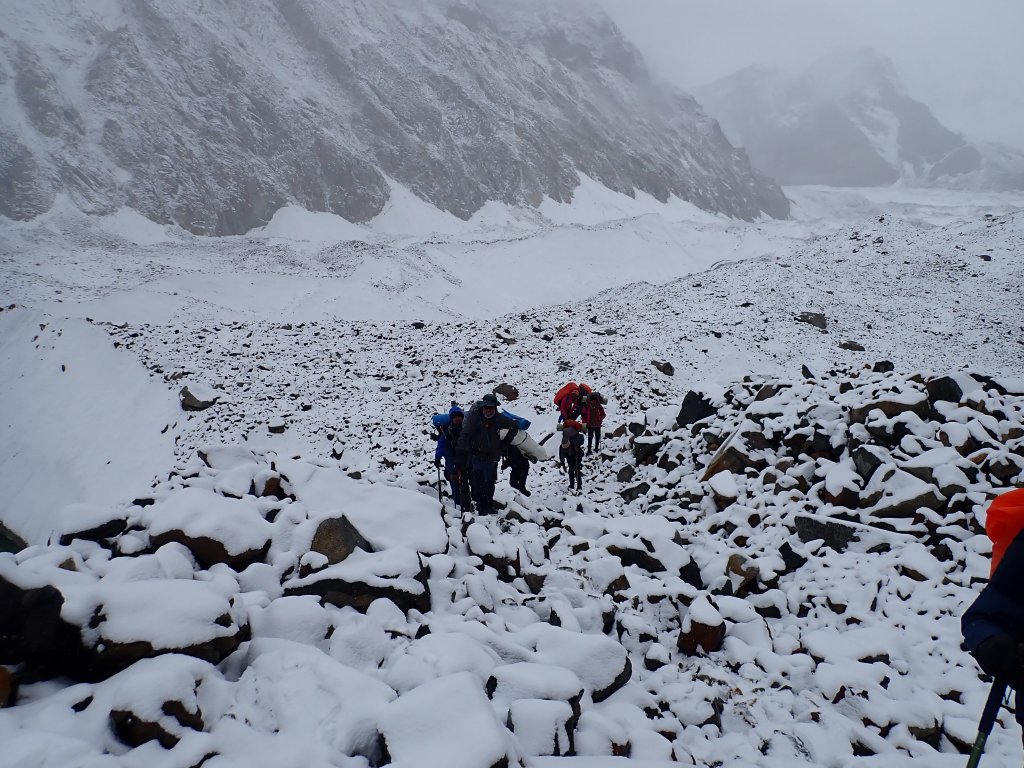
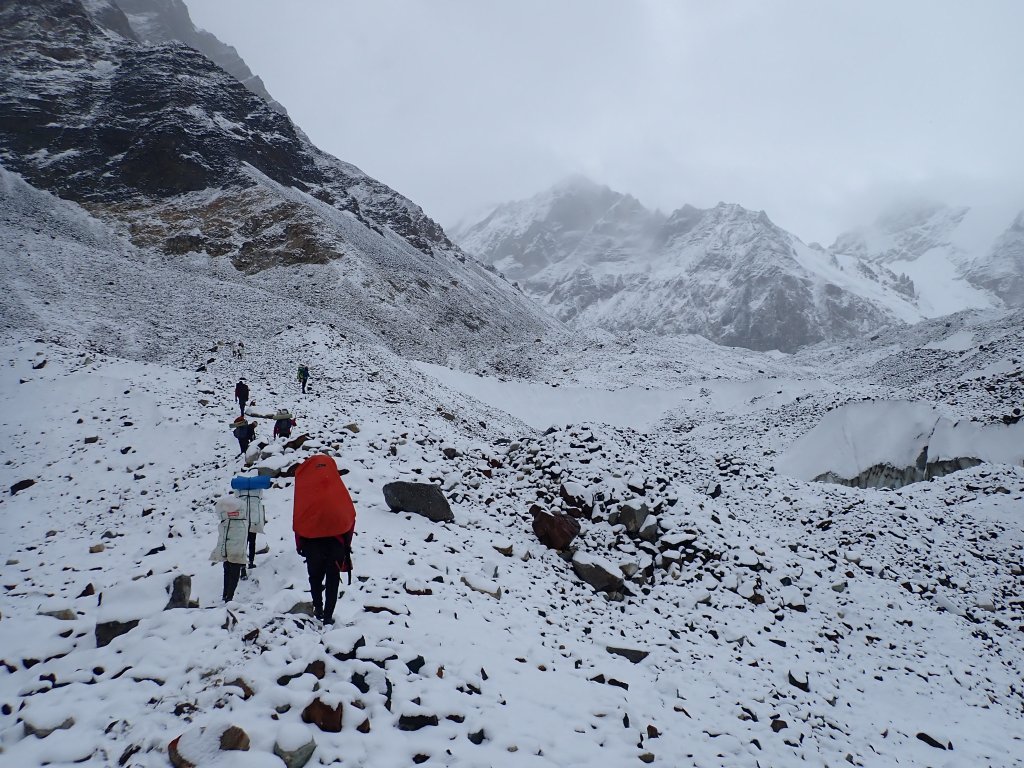
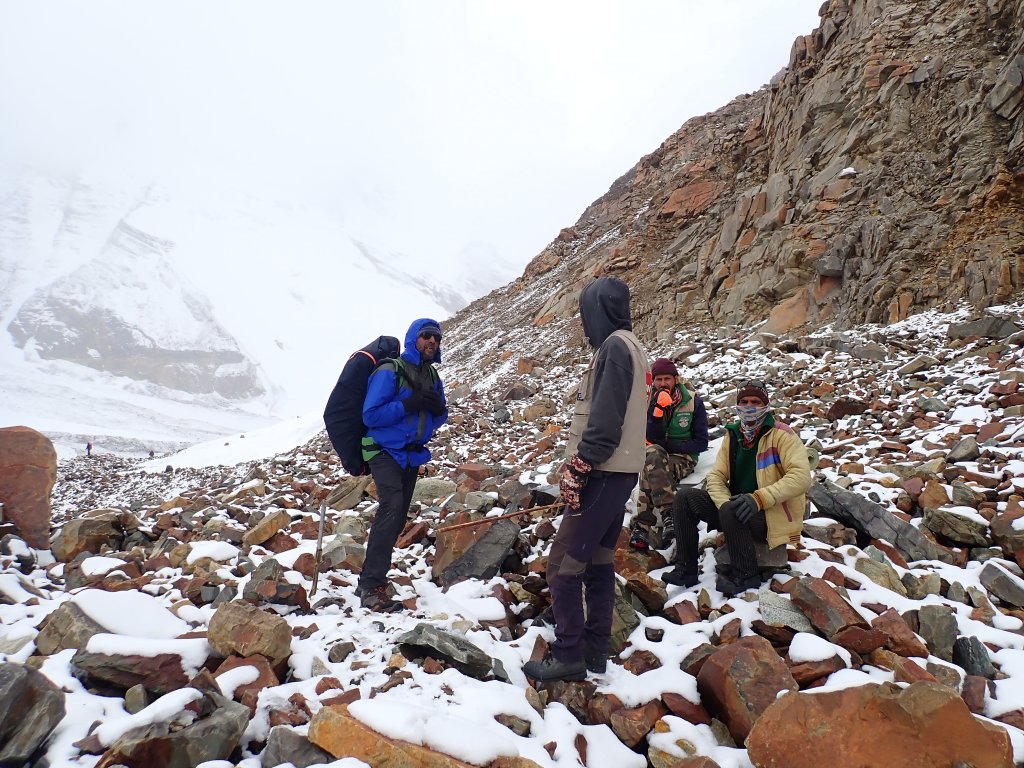
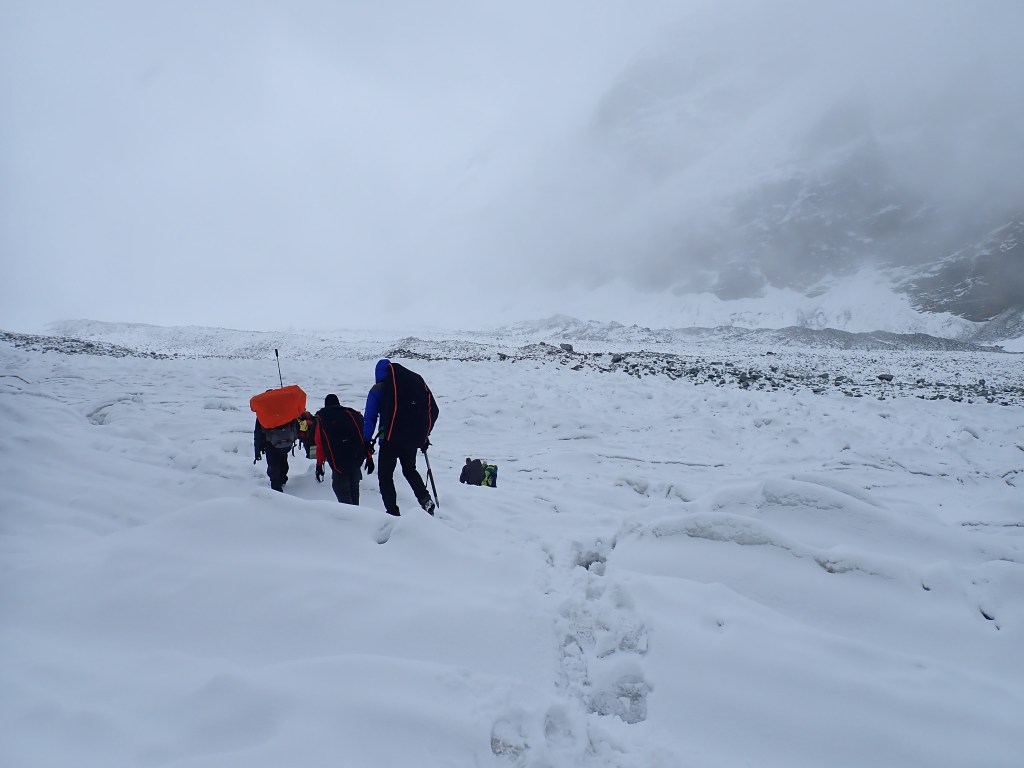
By the time we hit Khatling, it was already snowing. We started marching ahead behind our kitchen staff. The snow got heavier and our legs started going knee-deep. Luckily it was a very comfortable decline gradient through Khatling. We were all going in a queue. The only sound was of a blizzard ripping through our rain jackets and ponchos. Khatling was welcoming us in the most decent way possible. After a kilometer of walking, we encountered an agile depression. A flat ground was visible after the decline. The tents were not yet set up. We were the first batch walking, and it looked like a campsite location.

Snowing on Khatling Glacier. P.C. Arpan Sarkar

Just after the depression, one of our members fell into a hidden crevasse covered by fresh snow. All we saw was, he zipped out of sight vertically. We all gathered around the opening and took a sigh of relief to see him stuck near down. Sonu was just coming behind us. He threw his rope down and slowly we all pulled the guy out. The guy had offloaded his backpack and walked with only a nap sack. A full backpack could have saved him going into the crevasse itself.

Don’t know about the actual plan but Sonu decided to camp on the flat ground visible after that crevasse. A safe flat ground is enough for camping on an ice field. You have to melt snow for drinking anyway. It was 3:15 in the afternoon, and we got the big dining tent over all our heads. All were quite drenched. The guy who fell into the crevasse didn’t injure himself luckily. At about 4, once it stopped snowing, we pitched our individual tents. Guess what! It was sunny after the snow. The sunglasses were out again to face the crystal clear snowfield around. The dinner tasted like heaven after the day’s struggle. It was a crunchy snow-bed that night. After the rock and roll all day, our blubbering didn’t take long to stop eventually. Rahul Bhai, Raktim, and I were sharing a 3 person tent from the start. I got comfortable in my sleeping bag, sandwiched between these two fellows.

The Khatling campsite. P.C. Arpan Sarkar

11th June 2022 (Khatling Glacier to Bheelangana Riverside Camp-4002 mt; 9 km trek)

We were camping in the safest and most settled zone of Khatling. The encounter with the deadliest section was waiting for us. I was not feeling the best because of the freezing cold till the sunlight touched us in the morning. We started at 8:45. There was no doubt that roping up

Notorious and infamous. P.C. Arpan Sarkar

was mandatory. Kapil was leading us and checking for hidden crevasses with his ice axe on every single step. It was a dangerous territory for walking. Thick cream like Icefield had hidden crevasses on each fold. We were surrounded by broken icefalls and avalanches. The stretch continued for the next couple of hours. We barely progressed 1.5 kilometers in that time with precautions in action. Mt. Draupadi Ka Danda was a major peak visible on the west. To see Auden’s Col I looked back, the rabbit with the rocky ears was looking toward us.

Not quite a scoop of your sundae. P.C. Arpan Sarkar

Then came the moraine zone with the underlying glacier. We were approaching toward the snout and the glacier was totally broken. I have seen some video logs before but the route was barely similar. We were going way down from the famous waterfall. The earlier route used to pass beside it. It felt that the glacier depreciated a lot there. We climbed down an unsteady section to reach the base of the glacier. It was a rocky terrain mixed with emerging black ice. Too difficult to

The moraine over the broken glacier. P.C. Arpan Sarkar

identify the slippery black ice from the rock. A few of us slipped along the way. Then we started taking every single step cautiously. We ensured the rock with the walking sticks before stepping. In the middle, there was a place that looked steadier from the surrounding. We had our packed lunch there with a few sips of fruit juices. In front of us, toward the west, we saw a huge broken portion of the glacier. It looked like a snout. Even water was flowing out of it. But, the water was entering below the glacier again. Hence, it can be called a fake snout.

Colorful us over the monochromatic Khatling. P.C. Arpan Sarkar

After lunch, it was time to climb up to the other bank of the glacier. The terrain was completely different compared to the one we were walking. It was a steady earth with patches of grass over it. The flow of the glacier rattled the place. It was not an easy climb either. We crossed the broken sections with utmost attention. The glacier went down to a deep gorge and the true snout is somewhere below there. After the broken section, we found a mud trail to follow. Maybe

Ice, rocks, and the false snout. P.C. Arpan Sarkar

there was a trail from way back but it went down with the glacier. After a while, the trail took a sharp turn toward the south, along the gorge. After negotiating a rockfall zone on the way we came down to the riverbed. The tents were getting ready in a distance with some smoke coming out of the kitchen tent already. It was 6:30 when we reached the campsite.

Into the Bheelangana valley. P.C. Arpan Sarkar

Shallow, icy cold Bheelangana was flowing with great force toward the south-east. There was a hanging glacier way up on the other bank. This was definitely not a part of Khatling. We had some relaxed chitchats, sitting on the bank of the river with hot coffee and fries. There was a huge erect rock in our campsite. Support staff made a fire below it to dry the clothes. It was a

Pre-historic! P.C. Arpan Sarkar

prehistoric frame with people in front of the illuminated rock and the moon rising in the valley from behind the snow-capped peaks. It was one of those longest days of trekking in the wild.

Just to describe the mood of the night. P.C. Arpan Sarkar

12th June 2022 (Bheelangana Riverside Camp to Chowki-3715 mt; 5.8 km trek)

The very day decides the endpoint of the expedition. I have heard stories of a few teams. They ended the expedition in Ghuttu instead of Kedarnath due to river crossing failure. We were ready to cross Bheelangana in our shorts. The walk along the river started at 8. After an hour of walking, Sonu stopped us on a flat point. Somehow Rajiv managed to cross the river way back and was walking on the other bank. The major challenge was the ice-cold temperature of the water and the current. The depth of the river was never an issue as it was close to the snout.

Walk along Bheelangana. P.C. Arpan Sarkar

A support staff carried a line to the middle and thrown to Rajiv. Once the line connection was built, we started crossing one by one. The bags were covered by rain cover and the shoes were hanging on the neck. The key to keeping the body balanced on a shallow current is not to bring the foot out. Instead, you simply need to slide your foot underwater to take the next step. With some minor hiccups, we all crossed safely with a lifetime experience. River crossings were there in Kalindi too but not comparable to this. The other key was to gather the mental strength, that Sonu planted in us. All our legs were numb by the ice-cold water. It took about 30 minutes to get back to normal.

Bheelangana crossing point. P.C. Arpan Sarkar
Sonu, the leader fighting after all crossed safely. P.C. Amit Singh

People attempting the Mayali pass starting from Ghuttu often abandon their trek because of river crossing failure. The shepherds used to build log bridges to cross it, but there is no guarantee.

Paradise! P.C. Arpan Sarkar
Softness! P.C. Arpan Sarkar
Wild beauty! P.C. Arpan Sarkar

The other side of Bheelangana is a paradise. Lush green meadows with colorful flowers and birds chirping around made me remember Har-Ki-Dun. We had to cross 4 more tributaries on the way. The one just before Chowki made us go barefoot once more. One of our members injured himself during one of the crossings. He needed to be supported by others to walk the rest of the way to the campsite.

Tributaries running toward Bheelangana. P.C. Arpan Sarkar

Chowki is about 6 meters elevated from the river bed. It was a wonderful campsite that can fit a big team easily. We reached by 2. The plan for the next day was uncertain because of the injured member. He thought about calling for a helicopter too. Still, we were far deep in the wild to connect the civilization. The guides and support staff did their bit by massaging but it didn’t work.

Camp with a view, Chowki. P.C. Arpan Sarkar

13th June 2022 (Forced rest day at Chowki)

We decided to give the injured member a day to recover at Chowki. The whole day was like a picnic. The highlight was Raktim, Devdutt, Lijo, and I bathed after a long time in a serene lake nearby. It was a refreshing royal bath in the wild with a view of some snow-capped peaks up north. Nobody was in the mood for an acclimatization walk as there was simply no need after all

An aerial wide on a lazy morning. P.C. Arpan Sarkar

the ups and downs. In the afternoon, support staff collected wood logs and empty vegetable crates. They made a shoulder carriage to carry the injured person. However, 4 persons would be occupied to carry that. The rest of us needed to fill the void by carrying little extra loads from the next day.

Me, Lijo, Rakim, and Devdutt after a refreshing dip. P.C. Arpan Sarkar

14th June 2022 (Chowki to Camp below Masar Tal-4415 mt; 4.5 km trek)

We started early at 7:10. The valley was yet to get sunlight. Our injured member’s carriage was moving before us. We initially followed the trail on the west bank of the tributary of Bheelangana. The trail was very well-defined. Ghuttu and Ghamshali villagers trek to Masar Tal every year for religious activity. Mayali Pass is also a very popular trek attempted from both sides. At 8:30 we reached a lush green meadow with the first kiss of the sunlight. The gradients were not very insignificant, but we had already been accustomed to them for the last 10 days. We passed through some signs of Himalayan bears but luckily avoided a face-to-face meeting. Normally, these wild Himalayan animals don’t confront a group of people. There is a high chance of seeing them if traveling alone.

Incline through the lush green valley. P.C. Arpan Sarkar

At least 4-5 waterfalls were coming down our way to enrich the tributary. Almost the whole trail that day was covered by a lush green carpet of grass. After spending days between rocks and ice, they felt heavenly. The tangy smell of wild plants and flowers was all around.

Toward the high ground again. P.C. Arpan Sarkar

A 200-meter rocky wall stood in a 55-degree gradient after a picturesque meadow. A quiet waterfall was also descending through the wall to make the climb more difficult. It took us almost one and a half hours to reach the top of it. Then came a comparatively decent gradient covered by lush green grass cover. Streams were flowing in all directions around us. There are two big and one small lake uphill. All these streams are fed by the water of those lakes. Once after crossing that gradient, we reached our destination for that day. It was a very cozy and compact campsite with grass cover. Small elevations were on both sides of that place with a narrow and beautiful stream passing through the northern side. We pitched our tent just beside the stream.

After crossing the rock wall. P.C. Arpan Sarkar

By that time, people started getting a little impatient. Civilization was just a couple of days’ walk away from us. An efficient walk could even take us to Kedarnath in one day. Ration was running on the lower side, so the dinner was brief. The burbling sound of the stream by our side took us all to sleep quickly that night.

A cozy place to spend the night. P.C. Sanjay Varma

15th June 2022 (Camp below Masar Tal to Vasuki Tal-4251 mt through Mayali Pass-5150 mt; 13.2 km trek)

Long day started very early at 5. The sky was filled with blue and the peaks toward Khatling were already golden. The first target was to reach Masar Tal. The beginning gradient was not much

Start of the super long day. Leaving the camp behind. P.C. Arpan Sarkar

difficult, just some ridges and humps to cross. We reached near to a small lake that was misidentified as Masar initially. The actual Masar Tal was reached by 6:30, which was just a few

The small Tal below Masar. P.C. Arpan Sarkar

humps away from the smaller one. Masar Tal is bigger than Kedar Tal. It was fully melted at that time. This was probably because of longer exposure to sunlight every day. We kept progressing without spending much time. The agile gradient just after the Tal was technical. It is the

Masar Tal. P.C. Arpan Sarkar

ridge between the two lakes; Masar and Paiyan. The summit of the ridge is called Masar Top. Once after reaching the top at 7:30, we start the decline toward the bank of Paiyan Tal. Snowcover started to pave our way for the first time in this stretch. Along with it, the sunlight also touched us. Once after reaching down, Kapil went to search the route. The North side of the

Toward Masar Top. P.C. Arpan Sarkar

semi-frozen Paiyan Tal looked more approachable from a distance. However, we decided to approach through the rock wall on the south of the lake. Kapil found a major gap on the other side. It needed technical training to cross. Paiyan Tal is part of the Mayali icefall itself.

Descend toward Paiyan Tal. P.C. Arpan Sarkar

The wall on the south is almost 1.5 kilometers stretched and needed extreme attention to cross. The wall goes into the semi-frozen lake was filled with loose rocks, boulders, and patches of snow. It took about couple of hours for us to reach the base of Mayali Pass, crossing through the rock wall.

Paiyan Tal from the rock wall. Mayali Pass is seen on the right. P.C. Arpan Sarkar

We attached our crampons to the shoes to face the last major challenge of the expedition. I broke a small part of my tooth while adjusting a rigid crampon nail. The ice field was smooth

Paiyan Tal from Mayali Base. P.C. Arpan Sarkar
Toward Mayali Pass. P.C. Arpan Sarkar
The climb of Mayali. Paiyan Tal is seen far. P.C. Arpan Sarkar

and offered a decent incline. The sun was shining brightly upon us. After the initial 500 meters, we kept zigzagging for the rest of the incline. Our injured friend was climbing with support from the shoulders of a couple of staff members. It was too difficult to manage the carriage through that incline on snow. We reached the Pass at 12.

Mayali Pass- 5150 mt. P.C. Arpan Sarkar

The weather was turning cloudy slowly. It looked like the pre-monsoon window of Uttarakhand Himalayan expeditions about to get over. A puja was organized to acknowledge the mountain god for providing us a safe passage. We started to get down quickly as the thought of reaching Kedarnath was still there in some corner of our minds. Once after descending the snow field we had our packed lunch. The dark clouds were gathering over our heads. Heavy snowfall started in

Turning cloudy. P.C. Arpan Sarkar

a while. We were crossing a rocky descent and about to step into another snowfield. Ponchos came out of the rucksack. Everything turned to white within 15 minutes. The knee-deep snow started to haunt us again. Speed of our movement was slashed by half because of the time we took for judging before each step.

Long way to go. P.C. Arpan Sarkar

A rocky decend was situated just after the snowfield. The intensity of the snowfall went down. The terrain was a wide open valley. Many small and medium streams came from elevated locations. They ran toward the south-east to meet Mandakini River somewhere. We keep approaching being on the northern walls of the valley. We were praying to get a glimpse of the campsite as soon as possible. The dream of reaching Kedarnath has vanished by then from our minds. The desired sight of the campsite came at 5 pm. We were more than happy to get into a tent that evening. We reached the campsite after 15 minutes or so. It was set just beside the Vasuki Tal. The calm and serene lake was almost fully melted with some snow patches around.

The one in the middle far away is Mt. Kedarnath. P.C. Arpan Sarkar

We came to know after reaching the campsite that Sonu and Lijo progressed straight to Kedarnath. Everything hanging from our bodies was wet. The rest of us never considered progressing ahead that day, even in our wild thoughts. Khichdi served as a life-sever that night.

16th June 2022 (Vasuki Tal to Gouri kund-1982 mt through Kedarnath-3583 mt; 24 km trek)

Leaving Vasuki Tal. P.C. Arpan Sarkar

The morning was gloomy and we made some fire to dry our wet clothes. The ration went dry and we were on our personal stock of eatables that morning. Kitchen had only coffee to offer us. With the comparatively drier version of ourselves and the equipment, we started at 8:30. The ridge called Vasuki top was visible from the camp. However, there was quite a snow cover on the way.

Kapil staring at the Vasuki Top. P.C. Arpan Sarkar

We found one more lake on the way that was completely frozen. It took us a couple of hours to reach the top. From there onward, the route went continuously down to Kedarnath. The temple came

Down to the civilization. P.C. Arpan Sarkar

to vision within 15 minutes of descent. Helicopters were ferrying people down to the valley. The entire descent took about a couple of hours including calling breaks to home after days.

Kedarnath in vision. P.C. Arpan Sarkar
Just above the Mandakini valley. P.C. Arpan Sarkar

We parted with Sonu and his team. Then, we sat in a corner near Kedarnath temple. We observed the pilgrims roaming all around us. It was too contrasting with what we had for the last 12 days. Being there, we were neither overwhelmed nor disappointed at the same time. The journey that we made was a very rare and remarkable feat. It was very gracious of the ever-changing mountain weather that we crossed the significant stretch successfully. None of us wanted to spend the night in Kedarnath. Meanwhile, the 17-kilometer walk to Gourikund seemed a little too much. Me, Raktim, and Rahul Bhai tried for a darshan but failed for several reasons. Majorly, we were the only group that emerged from the mountains, the rest were registered for Yatra and Darshan. By looking into our burnt faces, people were raising their eyebrows. Some couldn’t control their surprise and asked for our whereabouts.HaHa!

Keadrnath Temple. P.C. Arpan Sarkar

We started the descent toward Gourikund at 3:30. At several points, I was disgusted by the crowds and the road full of mule shit. People were even dancing on the frozen waterfalls. At 8:30 we reached Gauri Kund.

We spent that night in a congested hotel room in Son Prayag. The next morning a SUV took us to Dehradun, and another one to Delhi from there. An early morning flight carried me and Raktim to Bangalore on the 18th.

Couple of dirty cavemen school friends. Me & Raktim. P.C. Arpan Sarkar

I count myself extremely lucky to be part of such a huge successful expedition that had so many variables. Kedar Tal is a trekking expedition by itself, we made it look like an acclimatization walk. Patangini is a hell of a climb straight away on a 3rd day. Navtej Ji attempted Auden’s Col before. He had to return from the summit because a team member was sick. There are so many similar stories. The Khatling puts you in a position where you can’t really plan the next step. Everything depends on your fate. The crossing of the Bheelangana River was extremely crucial to finish the expedition as per plan. I must give a huge shout-out to Sonu and the team for making it look achievable all the time. Many such expeditions end up in Ghuttu because of the leader’s lack of courage. The Mayali Pass and Vasuki Tal are trek routes by themselves. I guess this is the only trail in Uttarakhand that connects two Dhams of the four. It literally goes from temple to temple.

Sonu Negi. P.C. Mohit

There will always be variations in member’s performance, and we were not an exception. I think there were point of return to civilization on every alternate day in this expedition, unlike others. Still, all of our 15 members kept the mental and physical balance to continue till the end. It’s a very relaxing feeling when you start and end an expedition with the same team. I must mention Navtej Ji and Devdutt Ji. They are in their early sixties. I admire them just because of the mental fitness they have shown throughout. People call Kalindi Khal one of the most challenging crossover treks in India. I will rate this higher. You literally walk 10-12 hours every alternate day, why shouldn’t I?

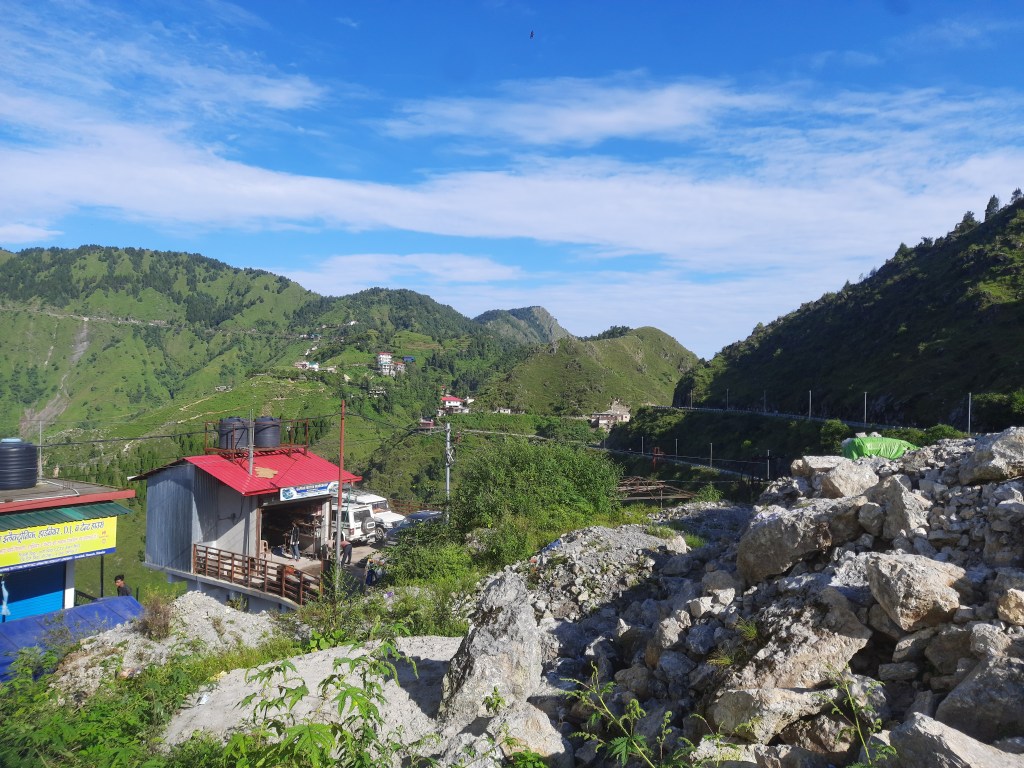
The Killer Kalindi Khal

      It feels amazingly thrilling when I write these blogs after an interval from the treks. This is kind of doing the trek once again in my mind. I try to recall every detail and all the memory of struggle and joy that used to cheer me up.

               So, this time it’s Kalindi Khal, a trek that needs no introduction. As far as my knowledge goes, Kalindi Khal is one of the most glamorous treks in India, standing with a maximum height of 5985 meters between Kalindi Peak (6,102 meters) and Avalanche Peak (6,196 meters). “Khal” in Hindi is similar in meaning to pass or col which is the lowest possible crossover ridge between two tall mountains. Kalindi Khal has a spiritual angle as it connects Gangotri and Badrinath, the two shrines of four in Uttarakhand. 

               Due to COVID-19, there was no treks in 2020. Many of my trek mates had planned Kalindi Khal a few times before, but it got canceled repeatedly because of many reasons including COVID-19. Kalindi Khal is a long trek and a comparatively expensive one too. That’s why the team needed to be absolutely sure of attempting it. Some of my trek mates were planning Kalindi in June 2021. But it got canceled again because of the 2nd wave of COVID-19 in India. I always had a plan of doing Kalindi in the post-monsoon season as my study suggested more success rate around that time. I was looking for an appropriate team as per my requirement, and around March I came across a very interesting two-liner post on a Facebook group. This post led me to Amitava Chatterjee who was trying to accumulate a team of appropriate trekkers for Kalindi Khal in September 2021. I jumped in immediately. My trek mates whose Kalindi Khal trek got canceled in June also joined in. Amitava Da was looking for a team size of 12 trekkers. After various additions and subtractions, the final number stood out as 10. The itinerary was to reach Gangotri on 3rd September and end in Badrinath on 18th September including a couple of acclimatization and a couple of reserve days.

               My preparation plan is simple, 5 days a week throughout the year. There can be a special addition in the workout before the trek but the core remains the same. I cycle 4 kilometers, run 4 kilometers, and do some freehand exercise five days a week throughout the year. In special addition to Kalindi, I hiked Golkonda Fort, Hyderabad, 5 times a day on the last 5 Saturdays before the trek. I must admit, this special hike did wonders for my legs and helped me throughout the trek. The rain of July and August was mostly in the latter part of the day, not in the mornings. So, my preparation remained uninterrupted.

               The hic-up before every trek has become a regular practice now. This time it was the roadblocks and landslides because of excessive rainfall in all the regions of Uttarakhand. Along with it, the COVID-19 protocols were varying throughout the states of India. Uttarakhand was very strict about the entry of tourists from other states. An e-pass was mandatory with all details of the tour along with and COVID negative RTPCR report. With all these documents and a backpack of 12 kilograms, I was ready to board my flight to Delhi on 2nd September. Two more trek mates, Navtej Ji and Siddartha joined me at Hazrat Nizamuddin railway station, Delhi. We boarded an overnight train to Dehradun.

3rd September 2021 (Dehradun to Dharali–2680 mt; 220 km drive)

               Nanda Devi Express reached Dehradun at 5:30 in the morning. There were four queues to test RTPCR reports and rapid testing was also available for those who did not have it. The arrangement was very agile. After all the formalities we come out of the station within fifteen minutes. A pre-booked cab was waiting for us outside. Anjan Da joined us there. He reached Dehradun on the previous night. We four set out for the President Hotel where two more of our trek mates, Devdutt Ji and Apurva were staying after reaching Dehradun on the previous afternoon. We freshened up in their hotel room. In the meantime, all our bags had been tied to the top of the car. We started at 7 AM.

               There was no certainty of staying at Gangotri because of the ever-evolving COVID restrictions. The nearest possible stay could be in Dharali, 20kms before Gangotri. The weather was cloudy in the morning but it got cleared as we progressed. We were literally sitting with sunshine on our back when we stopped for the breakfast. We set out for Uttarkashi after breakfast where Amitava along with Snigharup were making the arrangements for the trek.

From the terrace of a Dhaba at Subhakholi. P.C: Arpan Sarkar

The wheel kept rolling, and so did the weather. At lunchbreak, it was raining heavily. Amitava and Snigdharup with the arrangements were following us. To make things a bit challenging, one of the front tires got a lovely sharp nail in it. We found a scenic puncher fixing shop just beside the river Bhagirathi. After a 30-minute break, we had a nice drive along the river. We met another team of guide Uttam Singh Rana and his support staff on the way. They were about to start with a team of 15 for Kalindi Khal on the 4th. We got confirmation from Amitava that authorities were not allowing people from outside the state to stay in Gangotri. So, Dharali was the nearest option, and we reached it at 4:30 PM. In about an hour Amitava and Snigdharup reached. Kunal and Utkarsh also stepped out of a different car just about at the same time. We got a deal of 5 double bedded rooms at Rs. 2000 per day. Things got unbelievably cheaper because of COVID and less tourist footprint. They even provided us a space for cooking on the ground floor without any extra charge. In full-on yatra season, these rooms even get occupied at Rs. 4000 each.

Bhagirathi roaring downstream. P.C: Arpan Sarkar

               Our cook Mahavir and his assistant Pradip also reached along with Amitava and Snigdharup. They started the arrangement for dinner. It was a get-together time before we headed to the wild. Prior to boarding the train on the last day, I only knew Navtej Ji. We did a few treks together before. The rest of the group was only known to me on Whatsapp. Amitava, Anjan, and Snigdharup were coming from Kolkata. Devdutt and Apurva were from Pondicherry. Navtej, Siddhartha, Utkarsh, and Kunal are from Delhi. I was the sole member coming from Hyderabad. The introduction was easy as everyone had only Kalindi Khal on our minds. We had the legal and financial settlement before going out on a stroll.

Rain is yet to leave the mountains. P.C: Arpan Sarkar

               Dharali is a very small village before Gangotri. One might not notice the village on the way if the significance is not known. Firstly, Dharali is the base for Mt. Srikanta (6,133 mt) expedition. Secondly, Dharali has a temple known as Kalp Kedar. Thirdly, Mukhwa temple is the winter settlement of Mata Gangotri which is just on the opposite bank of Bhagirathi. Mukhwa is connected to Dharali by a beautiful hanging bridge. So we were already in the sanctum of the Great Himalayan peaks.

Dharali in the evening. P.C: Arpan Sarkar

               Mahavir is a very well-known person in the Gangotri region. It is not only because of his cooking; he has assisted many expeditions with some well-known mountaineers. He has also done Kalindi Khal 3 times before that. The dinner tasted awesome that night with some experienced talks about the route from Mahavir. The weather was very comfortable with some chills. I and Amitava shared a double room. There used to be many members always in our room as Amitava was the organizer. The road journey of 220 km got me tired. I slept early ignoring all the disturbances.

4th September 2021 (Acclimatization Day at Dharali)

               The altitude of Dharali is 2680 meters which is about 700 meters lower than Gangotri. This brought us the challenge of acclimatization. We always wanted to stay at Gangotri only because of the altitude. But COVID came in our way. We decided to have an acclimatization climb which is at least more altitude than Gangotri. So, the Sattal (seven lakes) opted as the most convenient option.

Morning at Dharali. P.C: Devdutt Lall

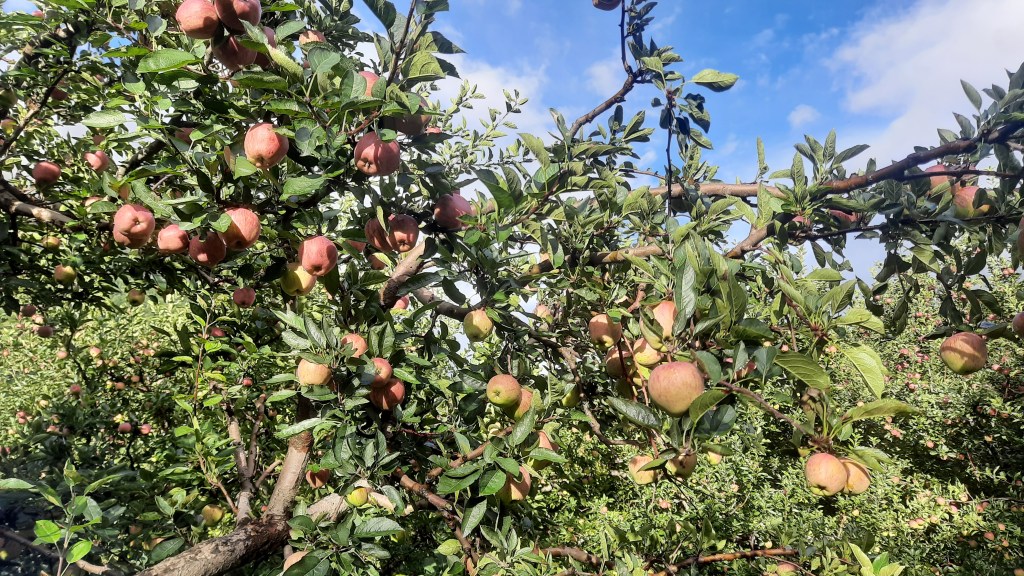
               After a nice breakfast, we started for Sattal at 9:30 am. This is a kind of off-beat day hike from Dharali. Navtej Ji never liked an acclimatization walk. But this was kind of not avoidable because of staying at a lower altitude. The route is a continuous steep ascent. In starting we crossed the village segment. Almost all the houses have at least one green apple tree in them. We were moving slowly as there was no fixed target point. After hiking for a couple of kilometers, we reached the first Tal.

The first Tal of the seven. P.C: Arpan Sarkar

There are seven like this as you go up. The calm green water and the forest around it were beautiful. We kept moving and stopped beside the fourth one. The altitude was already 5300 odd meters and then we had hiked more than 4 kilometers. Hence we considered the fourth Tal as the seventh.. HaHa. Kunal was carrying his videography accessories. His drone flew high above our heads and we all waved at it. After spending a celebratory hour, we decent to Dharali around 1:30 PM.

From the left: Dr. Siddhartha, Devdutt, Navtej, Anjan, Arpan, Apurva, and Amitava. P.C: Snigdharup Mitra

               Mahavir is a great cook, and the tasty food was like a solitaire ring in the mountains. After a delicious lunch, some people went daydreaming. I was watching India vs England test match. My only worry was how will India manage to cope with the English conditions without me watching. HaHa.

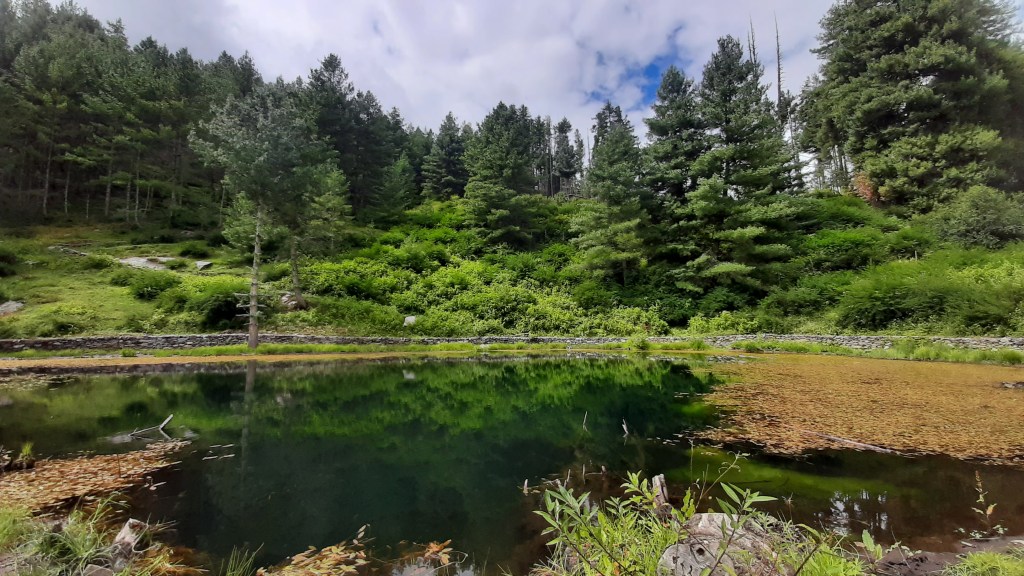
Apples in a home garden. P.C: Arpan Sarkar

               At about 4:30 PM we started for the Mukwa village and winter Gangotri temple. After crossing the suspension bridge and a decent hike we got the first glimpse of Mt. Srikanta on the opposite side. The golden sun rays on its western face made it absolutely mesmerizing.

The hanging bridge and Dharali village. P.C: Arpan Sarkar

There was an open terrace just beside the temple. We even got views of Mt. Bandarpunch and Mt. Swargarohini from there. All these surrounding peaks were glowing in evening golden light. None of us expected this much from the surrounding of Dharali. After visiting the temples, we got down to Dharali when it was about to dark.

An old wooden house at Mukhwa. P.C: Devdutt Lall

               The next day was a big one, as the first day in a trek always set the tone for the rest of it. We had our dinner at 8. After a stroll around in the dark, we got to bed early.

Mt. Srikantha in evening glory. P.C: Arpan Sarkar

5th September 2021 (Dharali to Gangotri-3023 mt by Car; Gangotri to Chirwasa-3651 mt, 10.6 Kilometers trek)

               Blue skyed morning started with loading the backpacks on the vehicles. We all were ready with our packed rucksacks last night. So, we started early at 7:30 am after a brief breakfast and a packed lunch in our bags. The weather condition was looming around our minds for the last few days. But as of then, it was a clear day. We ten along with Mahavir and Pradeep were in a couple of Boleros. The road leading to Gangotri kept gaining altitude as we move on. The Bhagirathi that was flowing beside us in Dharali, went into a 200 meters deep gorge, as we were about to reach Gangotri. We stopped a little far from the temple, as the police were not allowing travelers’ vehicles nearby. The support staff team along with guide Devram joined us there.

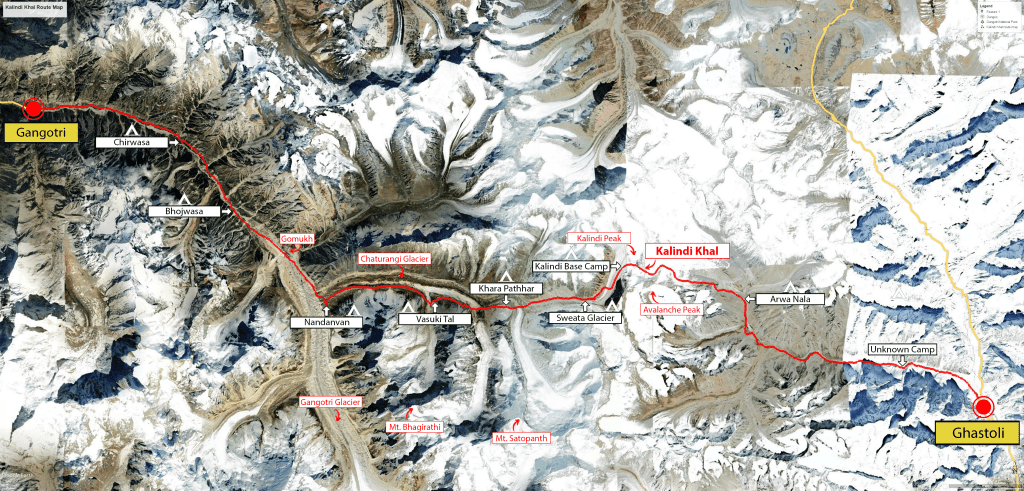
Courtesy: Google earth

               The weight calculation for porters is a really important aspect. Porters used to run away in case of weight mismanagement which is a bad dream for an expedition like Kalindi Khal. We had missed a trick by not carrying a portable weight machine. The distribution took almost a couple of hours. We kept exploring the surroundings. The place was really empty in the COVID situation. At about 10:30 AM we started with ten members, one guide, two cooks, and thirteen support staff.

The Gangotri temple. P.C:Devdutt Lall

               The Gangotri temple was about 500 meters away from the place we were preparing with our luggage. We stopped for a darshan. A pujari from Mukhwa referred us to get an entry inside the temple, as they were not allowing the public. We had some prasad after a brief puja. After filling all the water bottles and pouches from the temple premises, we moved forward.

We are moving toward Chirwasa keeping Gangotri behind. P.C: Arpan Sarkar

The trail leading to Bhojbasa heads straight from the temple keeping the river Bhagirathi on the right. After climbing a stair, you get to the main trail on the left. Sun was shining brightly upon us. The trail was surrounded by trees on both sides. We walked about a couple of kilometers before stopping at the forest office of Gangotri National Park for checking our permission and other documents. It was time for us to talk to our families for the last time before the trek ended.

Gangotri National Park Gomukh entry gate. P.C: Arpan Sarkar

The checking took place in real quick time with less crowd around.

Enroute Chirwasa. P.C: Arpan Sarkar

               The trail was really prominent and flat. Because of the comfortable gradient, it was a smooth walk. We were gaining height from the river bed as we progressed. Some jungles in-between gave us some canopy from the sun. Gomukh-Tapovan, being a very popular route for trekkers and pilgrims, used to be buzzing with crowds. But thanks to COVID that we met very few people during the whole trail. We crossed some rock fall section but it was not that dangerous

Some rockfall zones with streams coming down. P.C: Arpan Sarkar

comparatively. Some foreigners, returning from Bhojbasa greeted us with good luck. Mt. Bhagirathi sisters were always giving us the company in front. We got a glimpse of Mt. Manda on our left. Navtej Ji, Devdutt Ji, and I were going well ahead of the team. We reached the Chirbasa forest office and started waiting for the others to come. We were still willing to camp at Bhojbasa

The team coming along. P.C: Arpan Sarkar

that day but it all depends on the guide, once you are in the mountain. A hardly couple of hours were enough to cover the 9 kilometers till Chirbasa. But Devram was determined to camp at Chirbasa as we missed the altitude advantage of Gangotri. Mahabir arrived in some time and took us down, beside the forest office to the beautiful campsite by the riverbed.

Wild flowers enroute. P.C: Devdutt Lall
Wooden bridges over the streams were very helpful. P.C: Devdutt Lall

The flat campsite was mesmerizing with enough space for even playing football. There was a dome made for a stay without camping, our support staff along with Kunal went for it. The rest of us didn’t want to miss the feeling of camping after a long time. Mahabir started cooking after setting up the kitchen tent. We pitched our tents and went to the riverbank. The Bhagirathi

Bhagirathi flowing down beside Chirwasa campsite. P.C: Arpan Sarkar

was flowing west and beyond that, it was a 75-degree wall of an unnamed snowcapped peak that is connecting Mt. Brigupanth through a high ridge toward the south. If you cross this ridge, on the other side Kedarganga valley is waiting for you. We dip our legs in chilly Bhagirathi and spent the afternoon there. After a long time of COVID restrictions, we were finally “into the wild”.

Chirwasa campsite. P.C: Devdutt Lall

               Mahabir cooked a heavy meal for our dinner, as there was barely any lunch that afternoon. We fired up a few dried blocks of wood from nearby. It was a fantastic cold and starry night to remember.

6th September 2021 (Chirbasa to Bhojbasa-3827 mt, 6 Kilometers trek)

               The lazy day began a bit late for us. My tent partner was Siddhartha and Apurva. We had a nice breakfast and started at 10AM. It was a sunny day without a patch of cloud. The

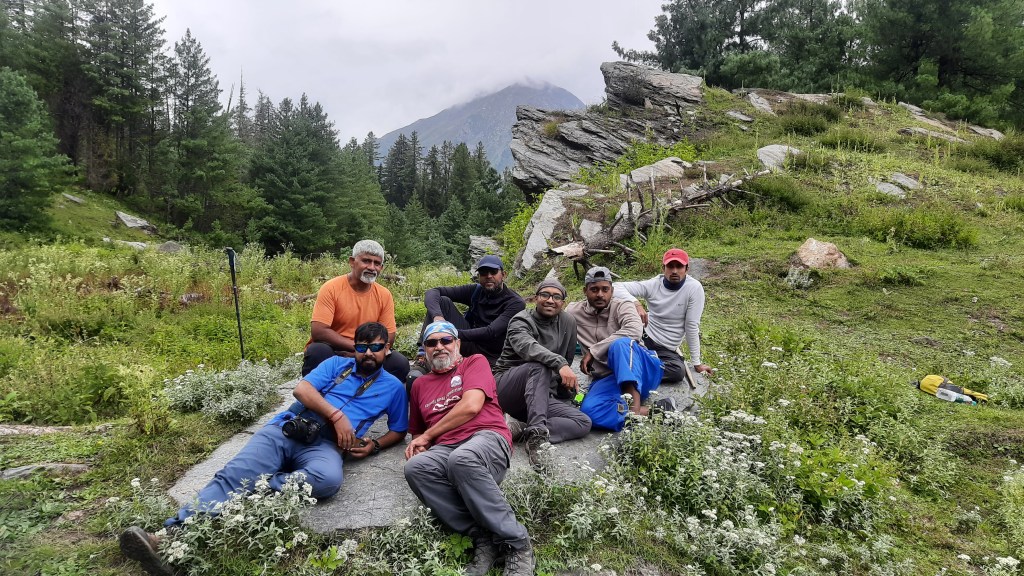
The whole group of members. From the left: Apoorva, Utkarsh, Kunal, Arpan, Siddhartha, Anjan, Amitava, Snigdharup, Navtej, and Devdutt.

distance we needed to cover was 6 kilometers, that too with only 150 meters incline. One can call this a very easy day. Devram warned us to stop before the marked rockfall zone and wait for him.

Some rockfall zones. P.C: Arpan Sarkar
Some unusual shapes of mountains. P.C: Arpan Sarkar

I, Navtej Ji, and Devdutt Ji started ahead of the group. We climbed the height that we declined last day, to get on the trail. The surrounding of the route was pretty similar to the last day. Only the rock fall zones were closer to each other and more dangerous comparatively. A couple of wooden bridges over the tributaries of Bhagirathi kept us on the trail. We reached the place Devram mentioned and started waiting for him. He arrived with other staff in 15 minutes and

Obeying our guide. P.C: Arpan Sarkar

moved on. The marked rockfall zone was not as dangerous as we thought. We reached the upper ridge of Bhojbasa by 11:30. From here, GMVN cottages, Lal Baba Ashram, and the military settlements including a dome were sitting below with Mt. Bhagirathi sisters standing tall in the far distance. People from all over the world come to Bhojbasa for yoga practices. Many yoga masters used to train people in the mighty Bhojbasa. Once the whole group got together, we walked down.

Approaching Bhojwasa. P.C: Arpan Sarkar
Bhojwasa with Bhagirathi sisters in the backdrop. P.C: Arpan Sarkar

               15-20 years back, it was possible for the trekkers to continue on the left side of Bhagirathi till Gomukh. A huge landslide divided the trail into two parts at around 2000. Since then, the route to approach Gomukh from Bhojbasa is on the right side of Bhagirathi. So, we needed to cross the river here. A manual pully transport system has been installed, roughly 5 years back to make the river crossing easy. Mahabir and Pradeep along with their kitchen stuff had been transported first, as they had to start preparing lunch. The first transport is always tricky here as the cart stop in the middle. Someone has to get down on the riverbed from the cart, cross the river and start pulling the line from the other end. Luckily there was dry space to jump on in the middle. Mahabir and Pradeep managed to make the first attempt smoothly. Similarly, all the support staff and members crossed the river successfully. This was a quite time taking process. Reaching the other side, we all helped the next batch by pulling the line. It was a muscle job for sure.

The transport over river Bhagirathi. P.C: Devdutt Lall

               A group of mountaineers from the Indian Army was camping on that side. They were on a load ferry for their Mt. Satopanth expedition. We set up our campsite 500 meters ahead of them. By the time the group reunited, Mahabir was ready with lunch. It was a lazy afternoon. Some fell asleep under the sun and some started chit-chatting. After spending a relaxing couple of hours, me and Devdutt Ji went for a stroll toward Gomukh. The landscape was rugged soil and rocks, along with patches of green. There were some thorny little plants with red, white, and purple flowers. The surrounding was beautiful and vibrant all around. We stopped after a kilometer as it was getting dark. We could see the grass line dissolving ahead toward Gomukh. The reason is not the height but the landscape of a big river being born itself.

Campsite of Bhojwasa. P.C: Arpan Sarkar

               That evening was starry as well. We spent a long time inside the tent discussing the challenges ahead. Dinner was served at 9:30. After dinner some dark clouds cover the sky and we got inside our tents.

7th September 2021 (Bhojbasa to Gomukh-4016 mt to Nandanvan-4479 mt, 8.5 Kilometers trek)

               We woke up at 6 with dense fog around us. The Indian Army’s Satopanth team had already started their load ferry by then. It’s going to be a long day for us as well, we have to cross the whole of the mighty Gangotri glacier. So, with some decent breakfast and packed lunch, we started moving toward Gomukh at 8.

March started on a gloomy morning. P.C: Arpan Sarkar
Bhagirathi flowing down in full glory. P.C: Arpan Sarkar

               Sunlight emerged when we were about to reach Gomukh. The landscape was somehow different than the rest of the trail. The last kilometer before Gomukh was totally sandy and flat with high cliffs on both sides. It was a nice and easy walk as there were no negotiations with bolder.

Nearing Gomukh. P.C: Arpan Sarkar

We stopped near Gomukh on hard ground, which is made with a mixture of sand, mud, and stones. On the east, way down we can see the snout from that place. The shape of the snout keeps changing by the time the glacier melts. Most of us kept our backpacks on some steady rock and descended toward Gomukh. The color of the ice is greyish blue.

The first glimpse of Gomukh. P.C: Arpan Sarkar
Gomukh. P.C: Arpan Sarkar

The huge wall of the glacial chunk is standing tall and from a blue snout river Bhagirathi is coming out. This is the birth of probably the most important and most worshipped river in India. Amitava, who lost his mother recently, was carrying her ashes with him. She always wanted to visit Gomukh but the wish was never fulfilled. Hence, her son decided to perform the ritual on Gomukh itself. We all prayed for peace for her departed soul. Kunal did some great camera works with his drone. He almost placed it inside the snout.

               After a good one hour, we started climbing the Gangotri glacier. Any active glacier is dynamic, so there can’t be a fixed route. We were struggling with the rough mixture of boulders, ice, and mud. Once we reach the top it was better to step on competitively. Me and Navtej Ji were hiking together. We found one trekker along with a porter descending toward Gomukh. He was Bharath from the team ahead of us. Due to early signs of AMS, he had abandoned the trek and was descending down to Gangotri. The rest of his team decided to carry on. It was a relief that this happened to him at Nandanvan. Higher camps could have been tricky to return from.

Marching on the mighty Gangotri glacier. P.C: Arpan Sarkar

               According to my study of vlogs and blogs of previous trekkers of Kalindi Khal, the hike of Nandanvan is one of the most challenging in the whole trek. Practically, Nandanvan was the first serious challenge in the trek so far. The rugged and unstable surface was very tricky to deal with. After crossing a comparatively flat surface with moderate cracks, we stopped for our lunch. The whole team got together. It was about 1PM. The weather got a bit cloudy.

Textures of the glacier. P.C: Devdutt Lall
We, standing opposite the Tapovan ridge; Gangotri glacier lying between. P.C: Arpan Sarkar
We had to reach below the cloud on the left side. P.C: Arpan Sarkar

There was quite a distance to cover. So, without taking a long break, we moved forward. After crossing a few unstable humps, we gathered below a 75-degree wall. The destination was above it. Everyone took some anticipation in their own way and Devram went for it first. One always needs to keep some distance from the one ahead in this kind of situation. Because even a rolling stone can be fatal. It was an almost 250-meter climb until we found the flat surface of Nandanvan. In between, we stopped for some breath on a small hump, which can accommodate a maximum of 3 people at a time. The view was magnificent from the edge. We could see Bhagirathi’s sisters and the mighty Shivling at the same time. The rest of the peaks toward Chowkhamaba was hidden by clouds at that point in time.

Campsite of Nandanvan. P.C: Arpan Sarkar

               We settled and pitched our tents around 4:30PM on the flat ground with two beautiful narrow streams flowing toward the Gangotri glacier. The place is heaven with a huge widescreen where we witnessed the drama of Mt. Shivling and the clouds. Every second was a new blockbuster. We managed to get a glimpse of the Kedar Dome and Mt. Kharchakund too. Bhagirathi 2 was blocking the view of her other sisters from our campsite. Dr. Siddhartha managed to convince Navtej Ji to do some stretching. It was quite an evening after a long day and more rewarding views.

Mt. Shivling in evening drama. P.C: Arpan Sarkar

I and Apurva were worried about our team in English conditions. We were expecting that the army, who were camping 200 meters from us might have information about it through a satellite phone. But Nah! Anyway, after a nice dinner cooked by Mahabir, we got inside the tent by 9 PM.

8th September 2021 (Nandanvan to Vasuki Tal-4962 mt, 7.3 Kilometers trek)

            The morning was full of sunshine and the drama of the clouds of the last evening was missing. The distance to the next camp is not much but Vasuki glacier and an almost vertical wall on the opposite side of the glacier stand as a decent challenge. We all had watched videos of trekkers reaching Vasuki Tal and it felt manageable though one has to climb gripping a fixed rope. We started around 9:30 AM. The delay happened because of some arguments happening between the porters and Devram. It was all about the weight distribution. A portable scale could have fixed all the issues, but we missed the trick.

Mt. Kharchakund and Mt. Kedardome in morning glory. P.C: Devdutt Lall
Morning preparation. P.C: Devvutt Lall

               The initial trail took us through some mid-sized grassland and some very narrow streams with crystal-clear water. We reached the famous ridge between Bhagirathi 2 and Chaturangi glacier. The visible path ahead was only the trail on the ridge. It was about a 3km long stretch. Beyond that, the fan-shaped Vasuki Parvat can be seen from that point itself. The mysterious sounds were coming from Chaturangi glacier on our left.

On the way. P.C: Arpan Sarkar

It was all about broken ice pieces falling in the glacial pools echoing on the surrounding ice walls. The feeling was surreal and very hard to explain. We marched forward on the ridge. The porters were going well ahead of us that day. Maybe they wanted to avoid further arguments with Devram. It was a well-defined trail but the indescribable views were stopping us repeatedly. The Bhagirathi 2 wall on our right was almost 80 degrees. I don’t think anyone ever attempted climbing on that. After a kilometer, we found some yellow-colored tents way down toward our right.

The mighty Chaturangi Glacier. P.C: Arpan Sarkar

I was wondering how these people will get their water as no source was seen nearby. Devram told us that near evening time a glacier-melted source opens up and that was the only way. Those people were set for Bhagirathi 2 and the summit was roughly 2-3 camps away.

The route toward Bhagirathi II summit. P.C: Arpan Sarkar
Looking back. P.C: Arpan Sarkar

               Once the ridge took a turn toward the right, we started going down to the Vasuki glacier, which originated more inside from Vasuki Parvat.

The fan of Vasuki Parvat. P.C: Arpan Sarkar

The way down was full of loose rocks, a very tricky part to handle. With the balancing act way down, as we got some window to look forward, surprisingly the opposite wall had very less similarities with the videos and images we have seen before. We couldn’t even see the fixed rope or any route to go up. Meanwhile, the weather got a bit gloomy. To add to that, a super chilly wind started blowing through the glacier.

The queue for climbing. The confluence of Vasuki and Chaturangi glaciers behind. P.C: Arpan Sarkar

None of us were prepared for this sudden shift in weather. But we were already in the middle of it and Devram was way ahead with the porters. We started to shiver and pulled out the main jacket from the backpack. Mahabir’s head popped out up on the ridge, and we took a deep breath. Through a very dangerous moraine and steep zone, Mahavir took us to a place where barely a person can stand. We could see a yellow rope hanging up and Devram was helping the porters to go up grabbing the rope. It looked way too challenging than what we were prepared for. The scene of the porters going up one by one from a very low angle was breathtaking. Devram started calling us, and I took the first attempt. He told me not to hang back and try to put as much weight as possible toward the front.

Climbers can’t be seen but the incline can be imagined. P.C: Arpan Sarkar

I followed the same. It was not that tough. But once I reach the top of that rock, which was hiding the whole thing from the opposite wall of the glacier, it was very tricky with barely any grip on my shoe. The slope was way down to the glacier, almost 350 feet. I crawled somehow and reached the ridge from where the Vasuki Tal could be seen way down on the opposite side.

Climbing successful. P.C: Arpan Sarkar

               One by one all our teammates climbed it safely. In the end, Devram came up and everyone thanked him for his support. We got to know; the previous route was completely damaged because of a huge landslide. This route was just opened by the army for their Satopanth expedition. We all gathered and clicked some snaps to remember a climb that would get our hearts in our mouths.

Vasuki Tal from the ridge. The camps of the other team are on the other side of the lake. P.C: Arpan Sarkar

               The weather was gloomier by the time we got down by the lakeside. We forgot to have lunch in the engagement of the adventure. So, before pitching the tent we settled on some scattered boulders and started eating. The place was a huge flat surface with all sides covered with height. The shallow lake, fed by the ice melts of Vasuki Parvat was situated in the middle. Both sides of the lakes were comfortable to set up camps for big groups. That is why people prefer Vasuki Tal for setting up basecamp of expeditions like Satopath. On the other side of the lake, two big groups were present with almost 7 tents each. They should be Satopanth expedition team and a group for Kalindi.

Vasuki Tal. P.C: Arpan Sarkar

               By the time we finished our meal, there were snowflakes. We all had chosen camping sites because there was no storage on a flat surface.  We had a little extended chatter that night as the next day was a rest and acclimatization day.

9th September (Acclimatization Day at Vasuki Tal)

               The late morning started with the sun picking between the clouds. Mahavir made a fantastic noodle for breakfast. After the meal, me and Navtej Ji went to the other side of the lake to meet the other teams. As assumed the last day, one of those was starting for Khara Patthar on the way to Kalindi. They were 14 members from the Karnataka mountaineering association with a big team of support staff. Uttam Singh Rana and his team were guiding them.

Sunlight on Vasuki Parvat. P.C: Devdutt Lall

We wished them all the best and moved to the other team. That was a team of successful Satopanth climbers. They just came down from the summit camp on the last day and were all set to move down to Bhojwasa that day.

Puja at the campsite. P.C: Devdutt Lall

               After we returned to our tents, Amitava called us for a puja arranged by our support team. In the mountains, these pujas are always very open and non-conservative. One can even offer chocolates and energy bars to the mountain god. We all prayed for our good fortune ahead.

Chandra Parvat. P.C: Devdutt Lall

               We again went for a stroll toward the route of Khara Patthar. We found a couple of memorial stones of climbers who lost their lives in Siachen glacier, I didn’t understand the meaning of putting the memorial in Vasuki Tal. We sat on a huge rock just beside the Chaturangi glacier. The whole place of Vasuki Tal is an elevated plain with glaciers all around. After a good sunbath, we returned to our camp and had lunch. The weather was getting dark slowly. The clouds covered the Vasuki Parvat fully by then. The rain and snow started after an hour. It was not heavy but continuous. Around 5 pm we got a break and went for a stroll towards the old route of coming into Vasuki Tal.

The Sunday feeling. P.C: Devdutt Lall

The landslide could be seen clearly.  After a good couple of hours, the rain hit back. Our dinner was served inside the kitchen tents. Till the last second before sleep, the raindrops on the tent were creating worries for the next day.

10th September (Vasuki Tal to Khara Pathhar-5140 mt, 6.4 Kilometers trek)

               The early day started with a cloudy sky and thick fog around. The night before was not of the best ones for me. Some oily food costed acidity in my stomach and got an interrupted sleep. The foggy and chilly air gave some

Into the rocks again. P.C: Arpan Sarkar

relief to my exhaustion. As it was a flat and bit crowded place, one has to walk a long way to find a place for nature’s call. By the time I came back from my temporary hideout, the weather got a bit clear. After an ice-cold splash of Vasuki Tal on my face, I felt very much relaxed. I didn’t take a risk of a heavy breakfast that morning.

Cross the glacier and take the left alley, simple. P.C: Arpan Sarkar

               We started moving on at 9AM. That morning, the management of weight among the porters was smooth accidentally. So, they were the ones leading the pack. But it was a bit late for some of us to realize that we, the members of the plains should not always follow the porters, especially when the task is to cross a mammoth glacier. Snigdha and Anjan were already down to Chaturangi when Devram called them back. I and Apurva were about halfway down.

Mt. Satopanth was hidden under the cloud. P.C: Arpan Sarkar

By the time we came up, the porters crossed a quarter of the glacier already, that too on a less recognized trail. From that ridge, we could actually see the huge head-up rock, for which our next campsite is named Khara Patthar, which means a standing rock. We again came down to the glacier where Devram wanted us to cross from. We came across some flags marked by the Army team on the Satopanth expedition. We were majorly walking on the Satopanth glacier till then. On our right, the mighty Mt. Satopanth was standing with the gorgeous tabletop shape, about a couple of kilometers away. Devram, who summited the mountain, roughly showed us the summit route. The white moraines of the Chaturangi are the contribution of Satopanth glacier. Going forward, we started walking on a glacier called Chaturangi but left only with three colors in it. It was a continuous and strenuous glacial walk. Snowflakes accompanied in several intervals along with sunshine. Around 2PM, we reached the gorge beside the Khara Patthar campsite.

Bumpy ride. P.C: Arpan Sarkar

               The complete gorge was full of huge boulders. We could see the way up to the campsite. But to reach the start of the climb, it was a kilometer of unsteady and giant boulders to deal with. That single kilometer took more than an hour. The struggle made us very hungry. We sat on the boulders before the climb and ate our lunch. The weather was playing hide and seek for the whole day. By the time we finished our meal, it decided to rain. So, the ponchos and rain cover came out and we started climbing the 150 feet vertical wall before it got too wet to grip.

Into the gorge. P.C: Arpan Sarkar

I have never seen a place like the one that came up after the climb. It looked like a meadow, but if one looks close enough, one can find out big chunks of moss on the boulders. Below the boulders, several small streams were flowing down to the gorge, which couldn’t be seen in maximum parts, but heard. Even some tiny red flowers were popping out on the mosses. The place felt like a true textbook description of Tapovan or the garden of heaven.

The mattress. P.C: Arpan Sarkar

I was the last one coming. So, without any hesitation, I pulled my poncho on my head and sat in the beautiful place. The campsite was within touching distance. As the rain got heavy, I rushed to pitch the tent.

Our campsite and the Khara Patthar. P.C: Arpan Sarkar

               In a while, hot soup has been served by Mahavir, who came up very early along with the porters. After an hour of rainfall, the sun picked between the clouds. We all came out of the tents to enjoy the golden hour. The distance was not a huge one that we covered that day, but the undefined route through the glacier took time. As the daylight dissolved, the rain resumed. We did dinner with snowflakes falling on our plates. As the night progressed, the snowfall got heavier. The tired legs and the sound of the snowflakes falling on the tight tents got me to sleep very quickly.

11th September (Khara Patthar to Sweata Glacier intermediate camp-5328 mt, 5.5 Kilometers trek)

The start of the morning was completely covered by clouds. The stones got slippery outside because of the fresh snow cover over them. People would have called it a rainy day easily if we were in school. So Dr. Siddhartha was keen to use the reserve day on the campsite. But Devram took a call to move on. Some porters were engaged in the same mess of weight distribution. Even though some of them were almost going back, Devram stepped in and solved the issue. We were in the middle of multiple glaciers, going back also wouldn’t have been easy for anyone.

Lazy morning. P.C: Arpan Sarkar

We started around 8:00. Devram warned us that it was a long day, maybe the longest of the whole trek. With moderate speed, the next campsite can be reached in 10-11 hours according to previous experiences. But as the route is completely through the glacier, the distance can vary against the previous experiences.

Initially, we hiked around a 150-meter ridge, where the Khara Patthar is located. Then a trail took us by the side of Chaturangi for about a kilometer. It was time to hit the glacier after that. A 100-meter descent through loose boulders and muddy soil landed us on Chaturangi again. Once you are on the glacier, you are on your own. There was no trace of any trail or markings. The usual drill of walking on the moraines and hard ice started, like the last few days. The weather was gloomy and there were occasional snowflakes which gave us some relief in the full-focused walk.

We took the left route after crossing the glacier. P.C: Arpan Sarkar

Chandra Parvat could have been visible with a clear sky. The route was 50 percent on the Chaturangi and then the confluence of Sweta comes in and you have to take left and walk along it. The Chaturangi was more of hard ice and had few untrustworthy boulders on it. Huge depressions of glacial ice with steep slopes down were meeting some glacial pools or snouts of aged black ice. We were walking along those steep ridges. Some loose step of someone was rolling a boulder down to the pool. The sound of it in that lonely remote place was cosmic.

The glacier welcomed us again. P.C: Arpan Sarkar

We stopped beside one pool for lunch which was middle of some boulders and reachable. So, it was expected to be less cold and drinkable. The packed lunch tasted great after the struggle of the whole 1st half.

Not a highway though. P.C: Arpan Sarkar

Everyone was a bit tired because of the long glacial walk in the 1st half. We started again after 30 minutes after lunch. All our water bottles got filled with the water of the glacial pool. The route after lunch was more on the confluence of two glaciers. The slopes we were passing through were steeper as we move on. There was one slope I remember, which can be called a technical one with almost 80 degrees slope, on a rock fall zone and we were stepping on completely loose boulders. Though we crossed it without any rope, it was a very tricky one to handle. After that crossing, we reached a place, where we realized that we were standing completely on the Sweta Glacier.  The Chaturangi could be seen behind coming from the right side. We were heading toward the left. It was already 4 pm and Devram told me that we need to walk for at least 4 more hours to reach the Sweta Glacier campsite.

How tiny are we? P.C: Arpan Sarkar

The weather was getting cloudier, on the other hand, it felt to be snowing in an hour or so. The porters were going much ahead of us. We kept walking. Around 4:30pm Mahavir said that there is a less popular intermediate camp in the middle of the glacier. Camping on a glacier is risky, but thinking of possible snow and night glacial march, we decided to camp there. The campsite was just a few minute’s walk from there.

Raw nature. P.C: Arpan Sarkar

It was not a designated campsite. It might have been used by the army, long back on their Kalindi expedition. We cleaned the small boulders and pitched our tents. A group of porters was well ahead of us. None were daring to call them shouting, as glaciers used to be fragile in places and cracks could have been triggered because of the vibration created inside the gorge. By the time Devram reached them and brought them to the camp, it started snowing.

Ice and rocks. P.C: Arpan Sarkar

The snow got heavier with time. We all got inside our tents. The elevation was already over 5000 meters. Spending some time outside would have been helpful but we had no other option. By the time dinner got ready, our surrounding was under 2.5 inch of the snow layer. But the intensity got lesser as the night progressed.

Enormous! P.C: Arpan Sarkar

We completed our dinner in groups. The only shed was the extension of the kitchen tent and a maximum of 3 people could fit at a time. The absence of a dining tent was a huge mistake by the organizer. It kept snowing all night but the intensity was low. We three, from inside kept tapping the tent the whole night in rotation.

Happy campsite to us! P.C: Arpan Sarkar

12th September (Sweta Glacier intermediate camp to Kalindi Base camp-5580 mt, 8 Kilometers trek)

The gloomy morning started early around 5. Anyway, we slept in rotation to keep the tent tapping for a while. The surrounding was fully covered by a blanket of snow. It was hard to step on the slippery boulders with the fresh snow cover on them. Finding the hide for nature’s call was a task itself as there were no big boulders nearby so we needed to walk a long way on those stones. Nothing was clearly visible on any side; it was a thick cloud covering all around.

Under a cold blanket. P.C: Arpan Sarkar

We had a brief breakfast and started moving around 7:30. It was a huge task to pack the wet tents. The intention of the early start was to avoid the snow as much as possible. The route was the same as the last day until we reach the west bank of Suralay Glacier. It was around 11:30 and the weather was a bit less cloudy than morning. Kalindi Khal could have been visible with clear weather from this place. A huge glacial snow patch was lying in front of us. This looked like a highway made of hard snow. Some shallow crevasses with ice-cold water flowing through them were lying in between the highway.

Not an easy walk. P.C: Devdutt Lall

Then the unexpected happened. On the other side of the glacial snow patch, a moraine ridge was visible. It was about 700 meters away from us. We saw a group of people emerge from the middle of a thick layer of fog, on that ridge. None expected anyone here and I was astonished by their dramatic appearance. I and Navtej Ji were waiting for others and by that time Mahavir reached. He said it had to be the group ahead of us. By the time our people gathered, the whole group become visible on moraine ridge. We get down on the glacier. The water flowing below could be heard.

We took the left after the ridge. P.C: Devdutt Lall

We crossed very carefully, Devram and Mahavir safely led our way on the tricky patch of hard ice. Once we climbed on the moraine ridge, the other group was ready to get down on the glacier. Several exited discussions and inquiries made the whole story clear to us. They started for Kalindi Khal at 8 that morning. Visibility was very less due to cloud cover and whiteout. Hence the delay. The approach was through the middle of the icefall to save time. But that enlarged the risk of crevasses. They were roped up and one of the members fell into a couple of crevasses in succession. There was no injury but the trauma of the incident made the member unstable. He was scared to move on. So, the whole team decided to go back to Gangotri. This shows great team bonding. But in my opinion, they could have decided to make the person carried up to the summit by some porters as they were very close to the summit. This could have given them an opportunity to cross less difficult terrain on the other side. From that particular place to Gangotri is comparatively tougher and there are almost 6 major glaciers to cross before they reach Gomukh. The guide was very discouraging, even with us. He even indicated that by looking at the weather around we would be unsuccessful to cross the pass too. Devram stepped up and gave us enormous courage. We didn’t even talk to that guide once after that.

Breaks were colder. P.C: Devdutt Lall

The moraine ridge was in the middle of the glacier. From the West bank, it looked like that would be the last ridge before the ascent of Kalindi. But there was another similar glacial snow-patch was waiting for us before we reach the final ridge. So, the same drill continued. Once we reached the last ridge, Kalindi Khal along with the huge Avalanche peak become fully visible. The weather was getting better toward the east side. This view gave us ample encouragement to cheer up.

Into the glacial highway. P.C: Devdutt Lall

Once we reached the last ridge, the feeling was that the campsite was nearby. But it took us two more hours to reach the base camp. The route was completely along the moraine ridge. We stopped just below the Kalindi Khal. The huge and

The speed breaker between. P.C: Devdutt Lall

scary icefall of Avalanche peak with blue ice in places was standing tall in front of us. Kunal flew his drone and got fantastic footage. We were all busy indulging in the heavenly landscape. Meanwhile, dark clouds from the West started surrounding us. Within 10 minutes it started snowing. We rushed to pitch the tents.

Cold but happy camp. P.C: Arpan Sarkar

This was the highest camp I ever spent a night at, more than 5500 meters. There was no point in standing out in the snow on a high camp like that, with the big day coming up. We all got inside the tents. Majorly, there was an indication of clear weather the next morning as a different part of the sky was showing glimpses of blue continuously. We had an early dinner. The plan was to be ready to move by 4AM the next morning.

A glimpse of Kalindi Khal. P.C: Arpan Sarkar

13th September (Kalindi Base camp to Kalindi Khal-5995 mt to Arwa Nala-5017 mt, 14 Kilometers trek)

The excitement of pass crossing and worry of the first glimpse of the weather after opening the tent zip didn’t let me sleep properly that night. I don’t think Devram slept that night at all. I was in a dizzy state and could hear Devram running around outside all night. I stopped trying at 4 and came out of the tent. The weather was opening for sure.

Blue is hope. P.C: Devdutt Lall

A glimpse of blue sky was visible on the pass side. We didn’t have that kind of sky till we crossed Gomukh. It was a sight that relaxed the anxiety inside me. Devram started calling everyone. A decision was taken to rope up everyone from start and to climb as close as possible to the southeast face of Kalindi peak. After all the arrangements we step on the ice field at 6. I must say, starting an hour before would have been helpful. Kunal and Utkarsh were in front of the row; Navtej, Devdutt, and Amitava were at the end of it. The rest of us were in the middle. It was a hard toil as we chose the toughest route to climb Kalindi Khal. The snow was less in places where the boulders were coming opening under footsteps. There were also places where up to knee it was going inside the snow.

Roping up. P.C: Arpan Sarkar

The unpracticed roping up also created some turmoil. Some of us were pulling due to their comparatively high speed and some of us were getting pulled. With all these pushes and pulls, it took 4 hours to reach the summit.

Ready for the big day. P.C: Devdutt Lall
Halfway! P.C: Devdutt Lall

At 10 am all of us including the support team reached the top of Kalindi Khal. The happy avatar of everyone came out. I was carrying the national flag. We all took a lot of photographs. Kunal took off his drone and captured fantastic footage of the summit celebration. The snowfalls of the last few days left the pass completely covered with snow.

The happy vibe on the summit. P.C: Arpan Sarkar

There was not a single stone visible in the surrounding. The side we climbed from was having clear weather. But on the other side, a huge cloud was approaching us. Because of the covering on the Badrinath side, none of the peaks like Kamet, Mana, Hathi were visible. Devram had given us a deadline of 30 minutes on the summit. We all got ourselves roped up again and started the descent at 10:30 sharp. We were happy to be on the top of Kalindi Khal but the monster-sized cloud gave us a frown in our celebration.

Kalindi Khal; 5980 meters. P.C: Utkarsh Yadav

The initial descent was moderate. The snow cover was giving us some cushion for our feet. It was an enjoyable walk after a 6000-meter pass. In an hour of descent, we got into the clouds completely. I was walking with my new microspikes. I must say, it was a completely wrong choice as it frequently came out of the shoes. The slope also got steeper and the visibility was getting less with time. We glissade some slopes and some we walked down. With the clouds engulfing us, snowfall also started. But walking along the ice field was fun. By 12 we were completely inside an absolute whiteout. All the sides were looking similar. The visibility was maximum of 10 meters.

Approaching the cloud. P.C: Arpan Sarkar
A brief gossip on the icefall. P.C: Kunal Chouhan

We were in the middle of nowhere. All of us put our backpacks on ice and sat on them. Navtej Ji tried GPS route tracking, but it conflicted with the route idea of Devram and Mahavir. Someone played a popular Kishore Kumar song and all got their attention to it as there was absolutely nothing to do or to see. Devram and Mahavir went for route searching.

Middle of nowhere. P.C: Arpan Sarkar
GPS signal lost! P.C: Arpan Sarkar

As per my calculations, we started moving from there, not before 2pm. The experience was completely out of this world. It felt like someone forgot to place the background behind us and some unknown characters are roaming around. The whiteout was also playing tricks on our eyes. Sometimes it felt like there is a huge rock wall in front of us, a minute later it turned into an ice field.

Not a planned frame! P.C: Devdutt Lall

We kept walking slowly as Devram and Mahavir led us to some unknown destination. They kept checking the depth and hardness of the ice with every step. It seemed that the cloud was standing in one place or might be moving in the same direction as us. So, there was no improvement in visibility. We crossed numerous crevasses on our way. Around 5pm we saw a valley and a wall of mountains at a far distance. Seemed like the ice field ending on the valley itself. The cloud got a bit thin and, in another hour, we reached the end of the ice field.

First glimpse of rocks after crossing the pass. P.C: Devdutt Lall

The moment we stepped on the boulders; the drizzle started. We removed the rope and without any delay started moving down. The campsite was being seen. The porters were ahead of us while descending. We all hoped that they found a suitable place to pitch the tents. The river that comes out of Kalindi icefield is Arwa. We kept moving down by the south bank of the river.

At about 6:30 the yellow kitchen tent became visible. Rainfall got a bit heavier by then. At 7 I reached the camp and found out that the groundsheet of our tent was missing. I did some arrangements with some rice bags and put up the tent with the help of Dr. Sidhhartha and Apurva. We all were wet including our backpacks. There was very little energy left that day to go to the kitchen tent and try drying some clothes. Mahavir cooked Khichdi and a sweet dish that night. Everything tasted remarkably good. A Combiflam helped me get relaxed and after a few happy discussions, I fell asleep.

14th September (Arwa Nala to Unknown camp beside Swaraswati River-4577 mt, 10.5 Kilometers trek)

The morning after, the struggling and glamorous pass-crossing was also a gloomy one. I had a sound sleep and was feeling fresh. After the experience we had after crossing, none really thought much about the weather. It was snowing occasionally. After breakfast, we started at 8:30 with a target to reach Gastoli at a stretch. Normally people camp twice after crossing Kalindi. But, with the last few days’ weather and it was mid-June already, we decided to reach the civilization as soon as possible.  The tents and some parts of the sleeping bags were still wet. But the excitement of reaching Ghastoli made us tolerate everything. The initial route made us follow the Arwa river. After a couple of

The Arwa nala camp in the morning. P.C:Arpan Sarkar

kilometers, we emerged into a vastly open valley just after the Arwa took a sharp East turn. As we progressed, behind a rock ridge the snout of Saraswati river opened up toward the West at a distance.  Many small streams were coming out of the snout. All these shallow rivers were playing around in that huge open valley. We removed our shoes and crossed the streams. Due to clouds and snowfall last night, the flow and depth of the streams were very less than expected. After the valley, we kept following the south bank of Saraswati. The gradient terrain was very comfortable to walk on. Small grasses and thorny bushes started coming under the feet. We crossed a place where we saw a mark of the designated campsite. We couldn’t see the confluence of Saraswati and Arwa as it was much away from the trail. After couple more kilometers, we reached a river that was flowing with comparatively more amount of water at a time and deeper. Shoes came out of the feet again. To cross this river usually people needed to fix rope on a sunny day, clouds saved our time in that aspect. After the river, we came to a place where many signs of camping were visible, but it was old. With some medium-sized rocks, ITBP marked their name on a sandy surface.

Arwa running toward Swaraswati. P.C: Devdutt Lall

All the indications were being very close to Ghastoli. A bit ahead of that place we came beside a small stream that was meeting Swaraswati very near to us. We crossed the stream but surprisingly there was no trail after that. We kept searching for any sign of trail but came out unsuccessful. Devram told us to climb the ridge just beside the river. We were pretty sure that the route follows the river to Ghastoli. So as there was no marked route, we stuck to the riverside and kept crossing numerous humps. There were many signs of recent landslides which might come on the old route.

The snout of Swaraswati. P.C: Arpan Sarkar

Kunal and Utkarsh were going ahead of me. Meanwhile, it got cloudier and within a span of 15 minutes, it was a partial whiteout again. I could barely see Kunal and Utkarsh. But there was no sign of anyone coming behind. I was a bit puzzled for a moment and decided to move on at speed and stay behind the two ahead of me. It was not a cakewalk over the rocky humps with slippery mosses over them. I fell and hurt my knee in the process but not losing vision of the people ahead was more important than the pain. Thick clouds around were even blocking the sound coming out of my mouth, shouting was not an option.

Hitting the whiteout again. P.C: Arpan Sarkar

We three gathered on a high ridge. It was a Y junction below. A small river was coming through a gorge and meeting Swaraswati from our right side. We all were confused about the route and started waiting for Devram. His silhouette emerged out of the thick fog after 30 minutes of waiting. We were relieved that everyone behind us was on a similar path to us. This unexpected change of route took the breath out of everyone behind. All gathered after another 15

Not lost though. P.C: Devdutt Lall

minutes. We started following Devram and saw the kitchen tent pitched in the distance after 30 minutes of walking. The visibility was getting lesser and it started raining as we were pitching our tents. None had any idea of the distance of Ghastoli from that place. Saraswati was roaring just beside the camp. A brief dinner with khichdi saved the souls that night.

15th September (Unknown Swaraswati Riverside camp to Ghastoli-3997 mt to Mana-3200 mt to Joshimath-1875 mt, 8 Kilometers trek/1.5 hours drive)

The morning was reminding us that all’s well that ends well.  It was absolutely clear without a single bit of cloud. I opened the zip of the tent with a doubtful mind about the weather and the sight was totally joyous. I woke up at 6 and started waiting for the sunlight to hit the valley. At about 7:45 a clean sunshine touched us after Bhojwasa. We gone

Sunshine atlast. P.C: Devdutt Lall

through a lot in last few days with bad weather and uncertainty looming around all the time. Now it was time to go home with a satisfied heart and a happy soul. We brought out our sleeping bags and all wet items from tents. Along with

With Devram. P.C: Arpan Sarkar

the moist gears, we sat in the sunlight. The river was looking dangerous last day in that weather but now it was soothing to sit beside. The ration was touching the bottom and only some noodles were remaining. Mahavir cooked it deliciously.

Three burnt fellas of the secret service agency. P.C: Devram Negi
We hit the trail again. P.C: Arpan Sarkar

It was feeling like a lazy Sunday morning. None were ready to move but we had to reach Ghastoli as early as possible to get an army transport for Mana. Although we had no idea of the distance to Ghastoli from that place. We start moving at 10:30. The trail was prominent beside Swaraswati. The most significant thing was the color of the river. If you mix a couple of drops of Cobalt blue in a bowl of milk, something similar may come out.

Looking back to the place that will remain in our heart forever. P.C: Arpan Sarkar

We kept descending with the amazing view of the valley. There were couple of loose rocky patches on the way. But after crossing all the glaciers in last few days, it didn’t hurt much. There were some streams coming from the ridge on South. None of them made us open our shoes at all. At around 1pm a huge ridge which was blocking the continued vision became visible through the gorge in distance. It felt like Ghastoli is situated just below that range. In another half an hour the green roofs of ITBP huts become visible. The Swaraswati is meeting another river here coming from the North and flowing down toward Mana. We crossed a small river and after a small walk got manmade road under our feet. It was feeling of rejoice that the expedition ended successfully.

Grassland!!! Just about to reach Ghastoli. P.C: Arpan Sarkar

The ITBP personnel were very welcoming. They welcomed us with tea and biscuits. After some documents checking and a photograph for their documentation, they arranged us couple of vehicles that dropped us in Mana. The road was

The actual team of heroes. P.C: Arpan Sarkar

beautiful with lust green meadows and high mountains on both sides of the road. They even stopped for us to see the amazing Swaraswati going underground in Bhimpool. We couldn’t thank them enough.

The Alakananda valley. P.C: Arpan Sarkar
Bhimpool. P.C: Arpan Sarkar

The Badrinath temple was closed for public due to restrictions. So after seeing the temple from a distance, we moved down to Joshimath in a hired car. Amitava and Dr. Siddartha stayed back with the support stuff. They were arranging to camp beside Alakananda.

Mana! P.C: Arpan Sarkar

That night we partied hard in the Joshimath hotel. The bath in hot water after 12 long days was very satisfying. None were in mood of sleeping even with the tired bodies.

Next morning, we booked a tempo traveller to Haridwar and started at 9. Kalindi Khal has always been a special trek for the trek enthusiast. So, the news of successful crossing got very positive responses. The tempo dropped us at Haridwar in the evening. Anjan and Snigdha took a train to Kolkata on the same time. Rest of us stayed in a hotel near to the station. Except Apurva, we all took a night train to Delhi. Next morning me and Devdutt took respective flights back home and rest of the people found their way home in Delhi.

Crossing Kalindi Khal is a huge achievement in my life. Firstly, it’s a 6000-meter-tall pass and secondly, I experienced so many aspects of naked nature at once. I still have dreams of walking on icefield and glacial moraine often. Luckily, all these are dreams of pleasure.